
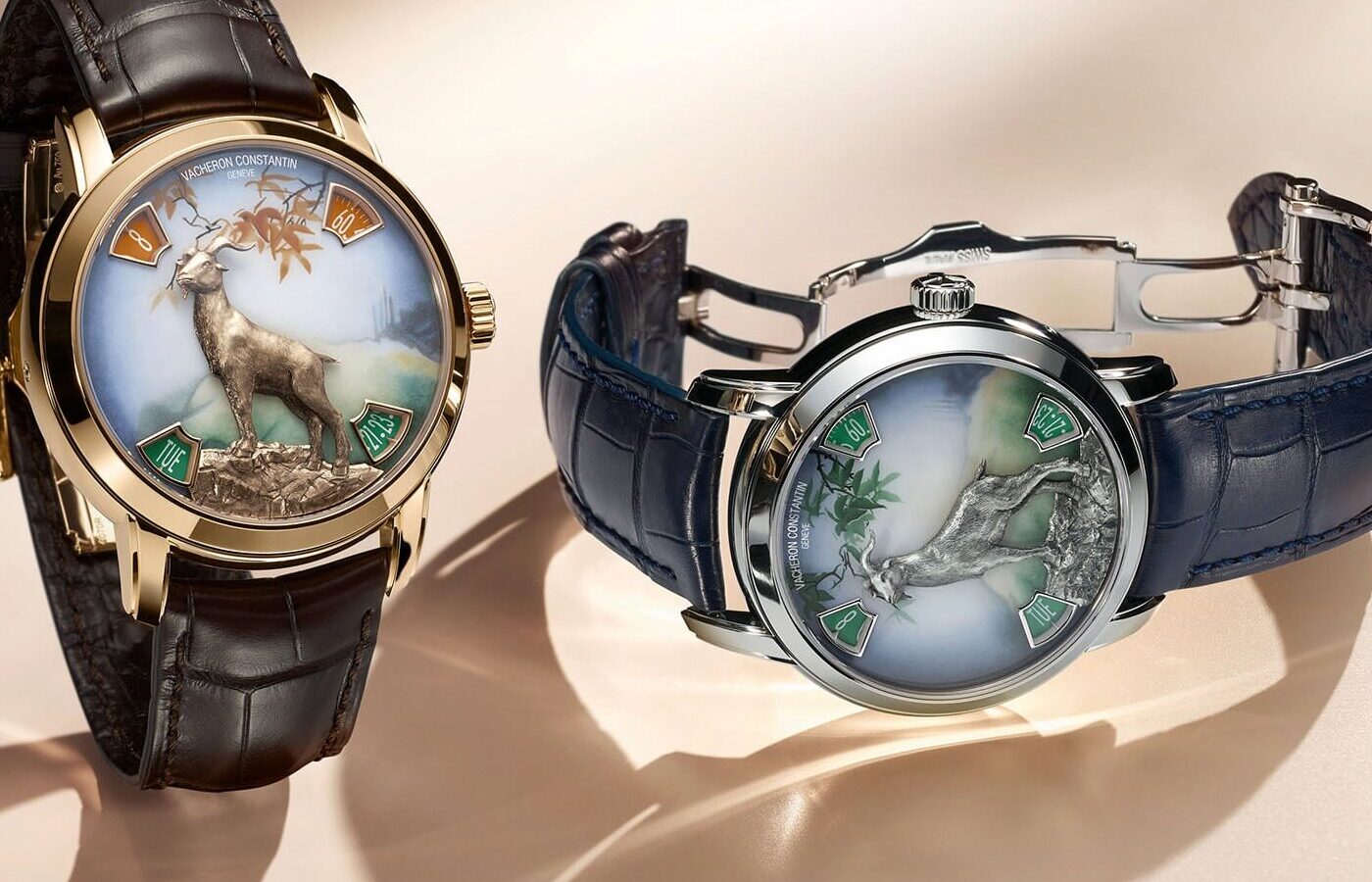
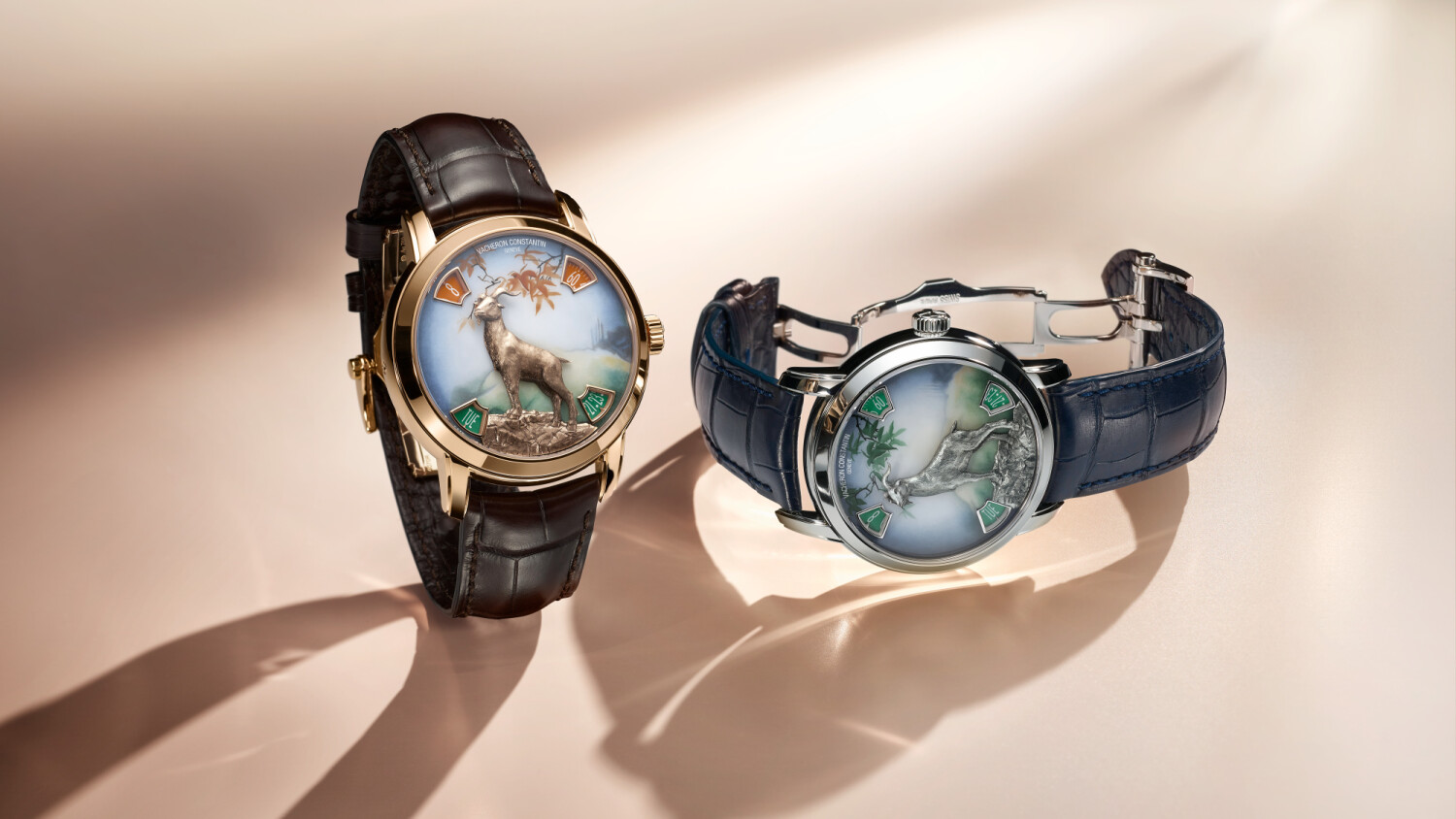
Vacheron Constantin has unveiled the latest instalment in its Métiers d’Art The Legend of the Chinese Zodiac series, a pair of 25-piece limited editions marking the Year of the Goat ahead of the Lunar New Year in February 2027. Reference 86073/000R-H105 comes in 18k 5N pink gold, and reference 86073/000P-H104 in 950 platinum. Both share a 40mm case measuring 12.72mm thick, and both are built around the same engineering premise that has defined this series since 2012: strip away the conventional hands so the dial can become a stage for sculpture and enamel.
A hands-free movement as dial design tool
The mechanism behind this is the in-house Calibre 2460 G4, a self-winding movement measuring 31mm in diameter and 6.05mm thick, built from 237 components and running at 28,800vph, or 4Hz, with roughly 40 hours of power reserve. Rather than sweeping hands across the dial centre, it indicates time through four apertures: trailing hours and minutes at 11 and 2 o’clock, and jumping day of the week and date in two windows lower on the dial. This is the structural decision that makes the whole composition possible. By pushing every indication to the periphery, the calibre clears the central field for the engraver and enamellist to work without a hand stack crossing the artwork. The apertures themselves are painted in colours matched to the surrounding dial details, so even the display mechanism is folded into the picture rather than sitting apart from it.
On the caseback, visible through a sapphire crystal, the movement shows an openworked 22k yellow gold oscillating weight with a polished Maltese Cross. The finishing extends to perlage, Côtes de Genève, hand-bevelled bridges and hand-finished jewel sinks, with the Hallmark of Geneva engraved on one of the bridges as a mark of both technical quality and execution standard.
Sculpting the goat: engraving, relief, and enamel in sequence
The dial’s central motif is a three-dimensional goat standing on a rock, rendered in 18k white or pink gold depending on the case metal. A master engraver sculpts the figure, then applies relief engraving to carve in finer detail, the curl of the horns, the texture of the fur. The contours are given a hand-patinated finish, with enamel miniature painting layered on top to pick out colour nuances in the animal and its perch. This combination of sculpted metal and painted enamel is what gives the goat its sense of weight and quiet stillness against the dial background, an effect that depends on the apertures staying out of its way.
Behind the goat, the landscape is built entirely in multi-coloured Grand Feu enamel, applied in a gradient that shifts in tone across the dial plate, with miniature painting used for the foliage. The process is laborious by necessity: enamel is applied in successive thin layers with a fine brush, then the whole dial plate is fired in a kiln, a cycle that takes around two weeks and is repeated as many times as needed to reach the right depth of colour and tone. Because Grand Feu enamel can shift or crack under heat if layers are too thick or uneven, this slow, repeated firing is the only reliable way to build up the gradated mist effect visible in the finished piece.
Proportions and the case as a frame
At 40mm across and 12.72mm thick, the case is sized to carry a busy, dimensional dial without overwhelming the wrist, and the choice of platinum or pink gold for both case and engraved figure keeps the palette coherent rather than competing with the enamel colours. Water resistance is rated to 30m, consistent with a piece intended for occasional wear rather than daily utility. Each watch is paired with a hand-stitched alligator strap, in dark brown for the pink gold version or dark blue for platinum, closed with a folding clasp in the matching case metal featuring a half Maltese cross motif.
Context within a longer relationship
Vacheron Constantin’s ties to China date to 1846, when the Maison sent 33 pairs of watches to Canton, items built to withstand humidity and often decorated with engraving, enamel and precious stones for Chinese dignitaries. The zodiac series launched in 2012 and began a second twelve-year cycle with the Year of the Snake in 2024, each year realised across two models. The Year of the Goat continues that structure, with the goat’s traditional associations, strength, resilience, gentleness, loyalty and good fortune, translated directly into the sculpted figure at the dial’s centre.
Both references are limited to 25 pieces per metal, with full details available through Vacheron Constantin. For collectors and design-watchers alike, the piece is worth tracking less for its rarity than for how plainly it demonstrates a working principle: when a movement is engineered specifically to get out of the way, the dial can carry sculpture and enamel work that a conventional hand-set layout simply could not accommodate.