
Grönefeld has built its entire modern identity around the 1941 case and dial architecture first introduced with the 1941 Remontoire in 2016. The new 1941 Quadrivium, unveiled on September 23, 2026, takes that same visual language and asks it to do something it has never done before: display a 7.5-second remontoire, a one-minute flying tourbillon, and central jumping seconds simultaneously, on a single 40mm dial. It is the most mechanically dense watch the Dutch brothers Tim and Bart Grönefeld have produced, and the layout had to be rethought to keep it legible.
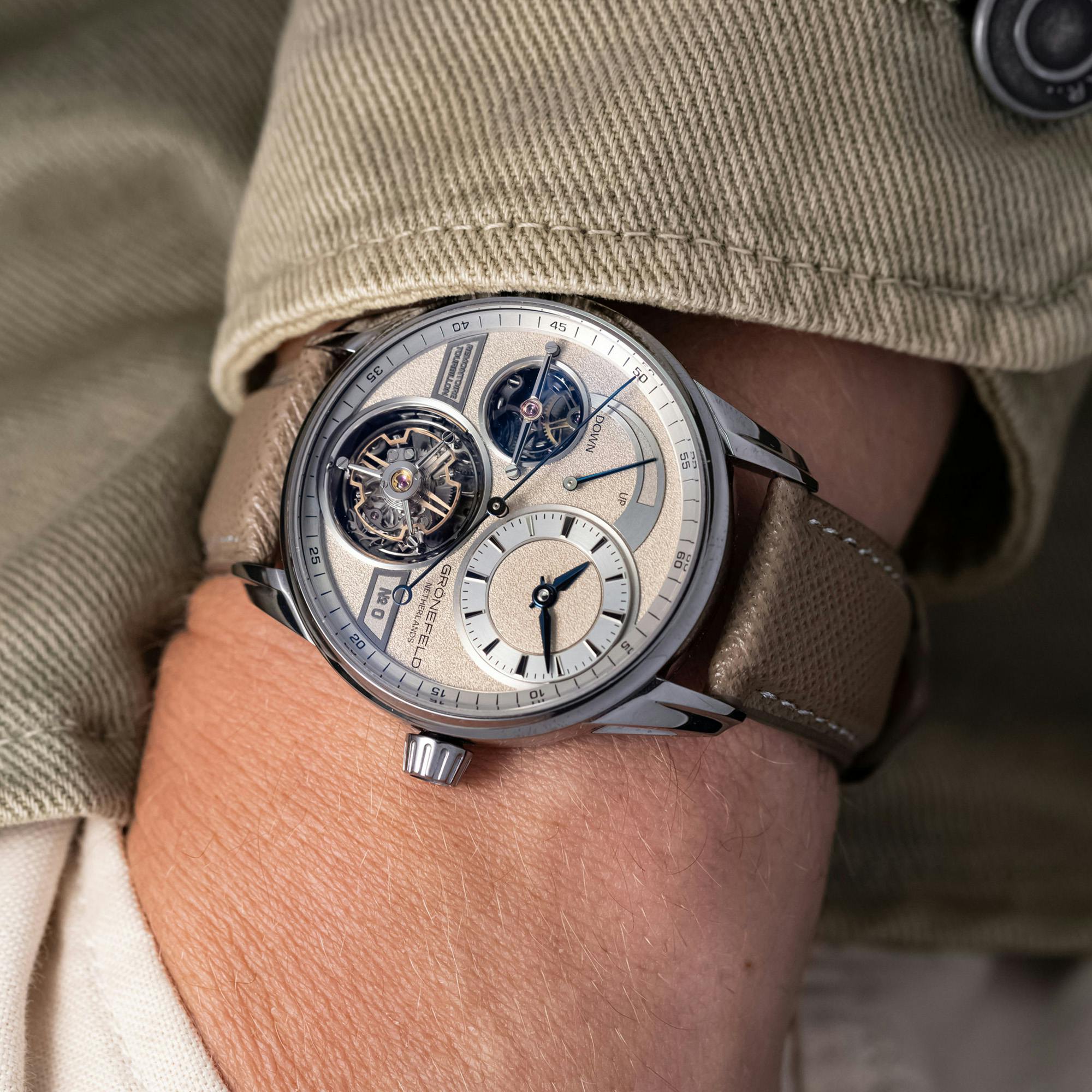
The case measures 40mm in diameter and 11.30mm thick, proportions the brand’s press materials call “reasonable” and “modest” given what sits inside. It is offered in tantalum or platinum, two of the densest metals used in watchmaking, which means the piece carries real heft on the wrist despite its compact footprint. Sapphire crystals front and back expose the movement from both sides, and the case retains the sculpted casebands, concave bezel and lug profile, and the brand’s familiar conical crown that have defined the 1941 family since the Remontoire.
Rebalancing the Dial for Four Functions
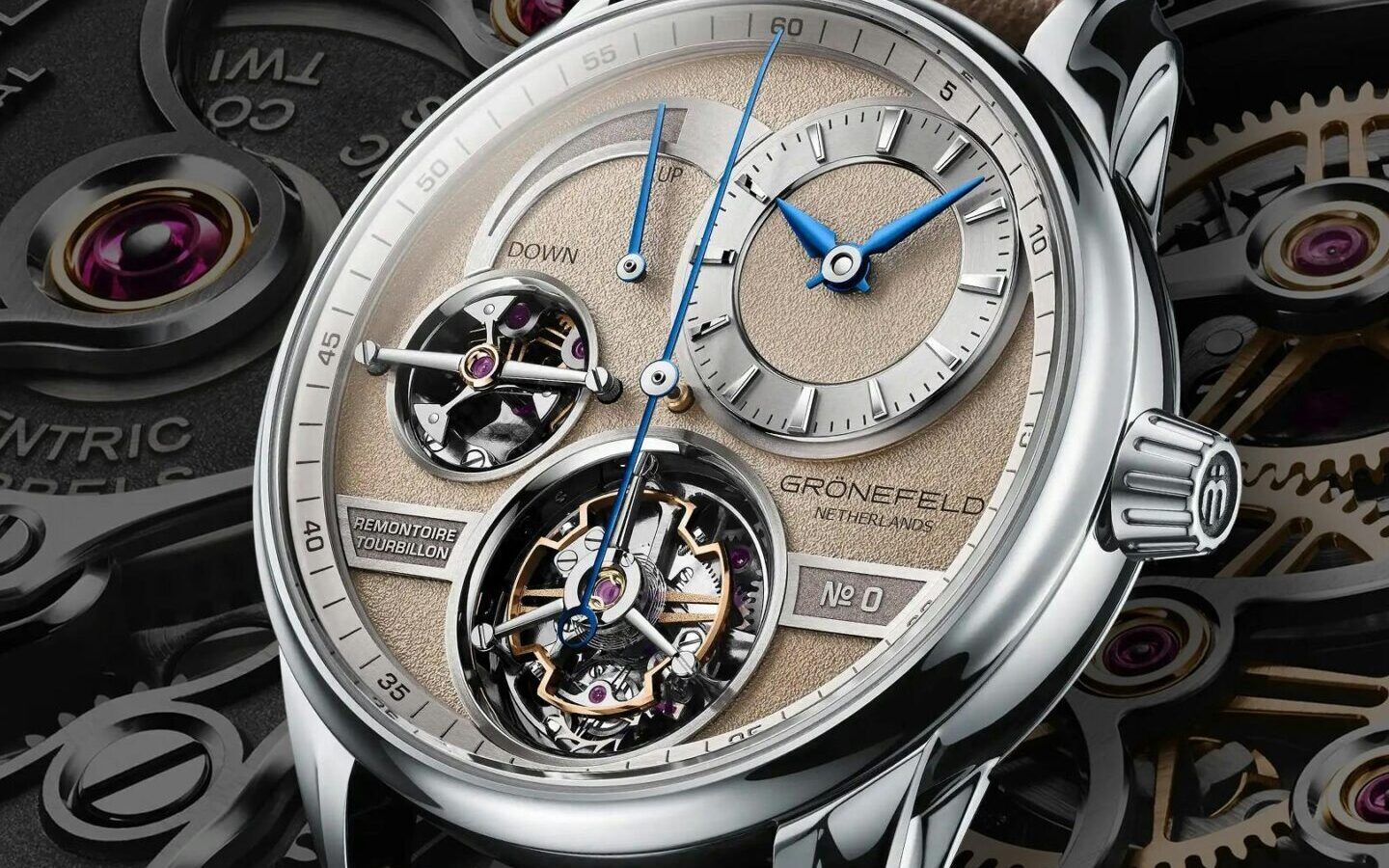
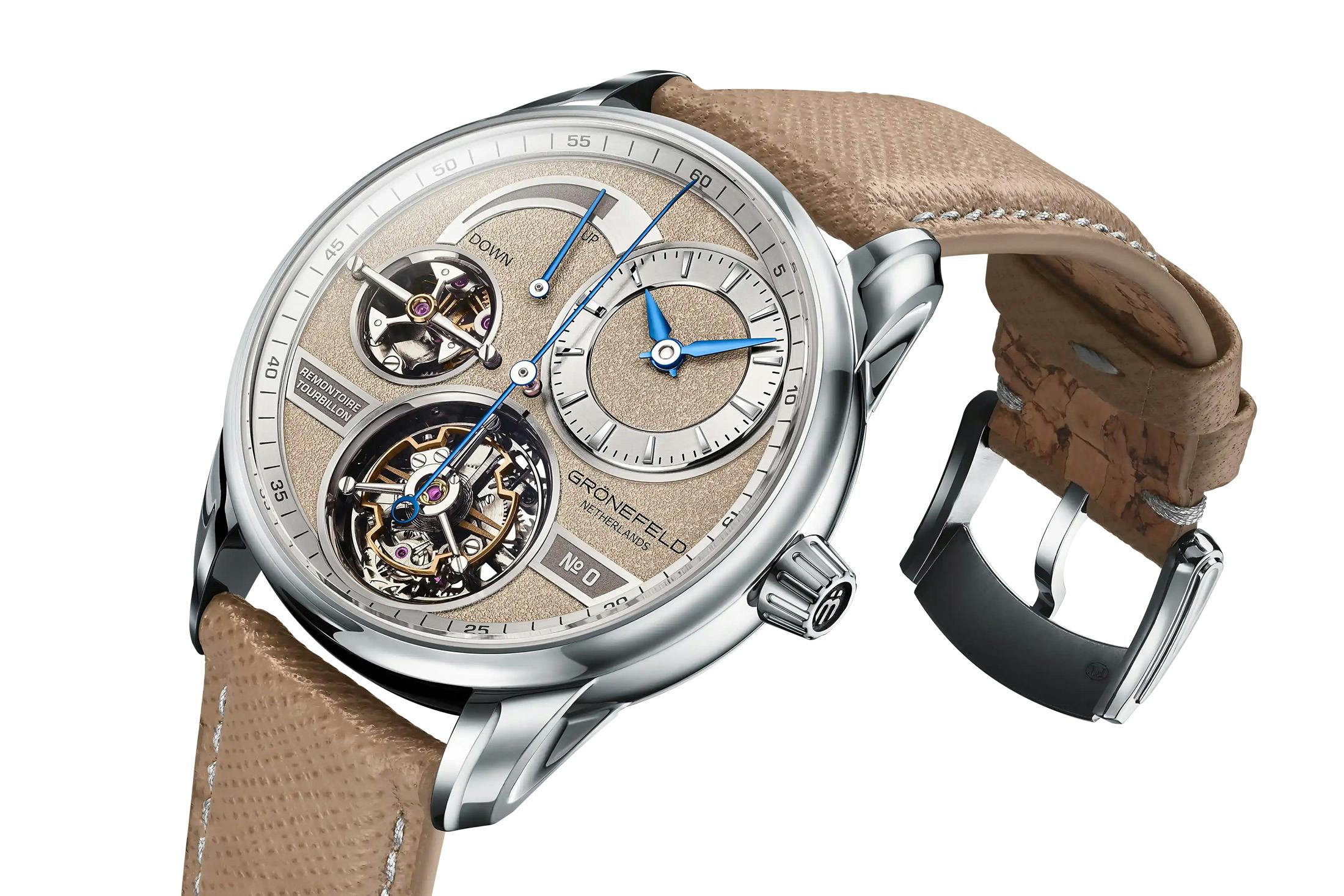
Fitting four distinct displays onto a 40mm surface without the dial collapsing into visual noise is the real engineering problem here, and it is solved through off-centring rather than stacking. The hours and minutes are displayed on an off-centre subdial positioned between 12 and 3 o’clock, fitted with polished, multi-faceted white gold hour markers and blued steel hands. A power reserve indicator, also with a blued steel hand, sits in the upper left. Two small cartouches lower on the dial carry the watch’s individual number and the words “remontoire tourbillon.”
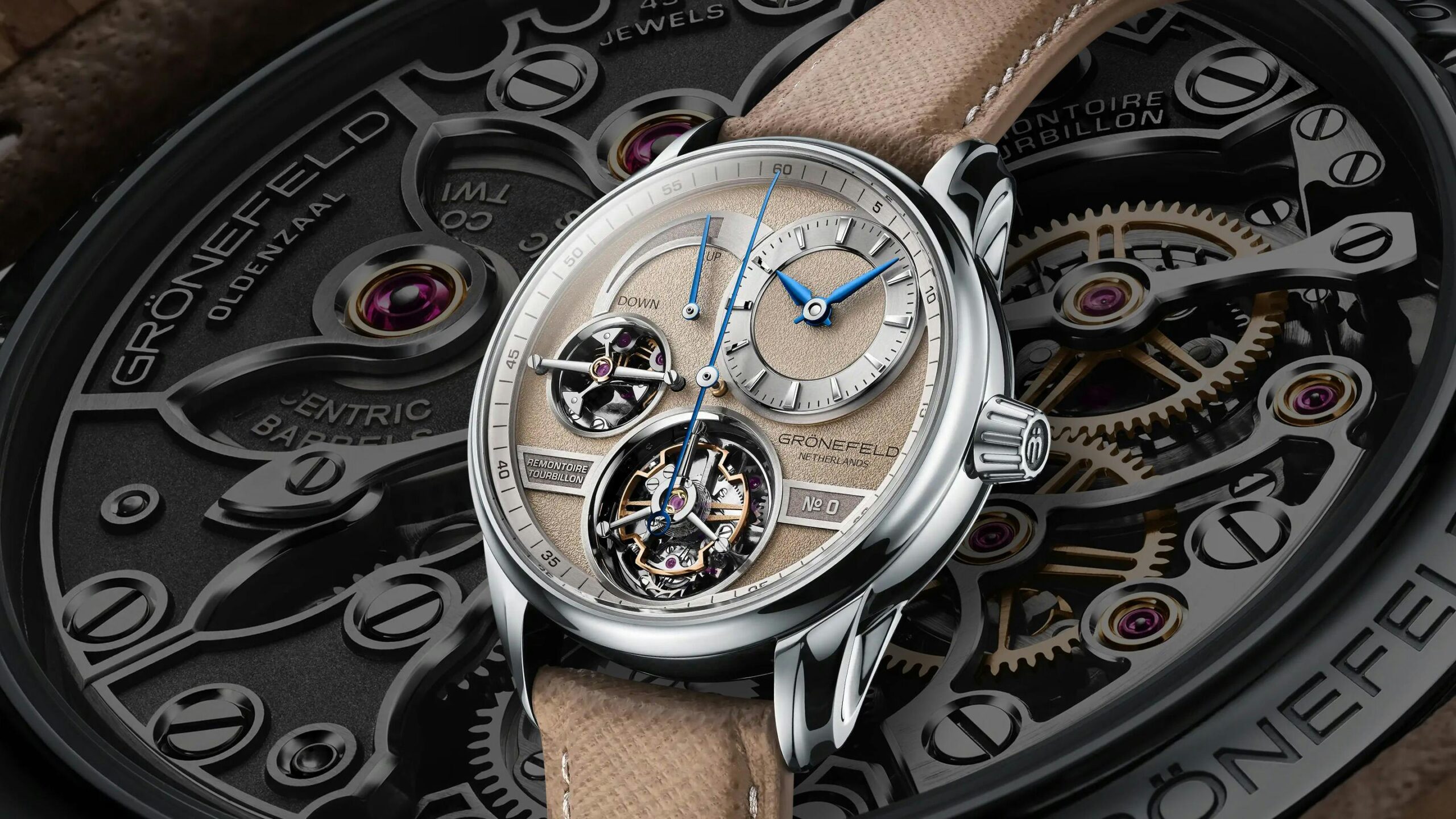
That leaves the lower half of the dial to the mechanism itself. At 6 o’clock, a slightly raised flying tourbillon rotates inside a hand-finished, three-spoke stainless steel cage, fitted with a smooth stop mechanism at the 60-second mark that functions as a zero-reset. At 9 o’clock is the exposed governor of the remontoire, a component carried over conceptually from the original 1941 Remontoire, spinning once every 7.5 seconds and making the constant-force delivery to the tourbillon visible in real time. At the centre, a jumping seconds hand advances in discrete steps rather than sweeping, a mechanism known as deadbeat or seconde morte, and it’s this hand that gives the watch its constant, almost mechanical pulse. The name Quadrivium, borrowed from the classical four-subject curriculum of arithmetic, geometry, music and astronomy, is meant to reflect this four-part display.
The base dial itself is finely frosted, shown here in a soft champagne tone, with every functional element picked out in hand-bevelled stainless steel to separate one layer from the next. Grönefeld has indicated that five base colours will eventually be offered, though full details on those variants are still to be announced.
Movement Architecture Behind the Layout
None of this dial choreography works without a movement built to support it structurally. The new in-house calibre comprises 49 jewels and 473 components, including concentric twin barrels connected in series. That series-barrel arrangement is not primarily about power reserve, which is rated at 50 hours, but about delivering smoother, more even torque into the remontoire and tourbillon regulator. A remontoire is, by design, a small secondary spring that charges and discharges energy to the escapement in fixed, repeating proportions, sidestepping the natural torque decay of a mainspring as it unwinds. Here that discharge happens every 7.5 seconds, a notably longer interval than the once-per-second remontoire mechanisms found in many other constant-force watches, and the visible governor on the dial exists specifically to absorb shock from that periodic energy release before it reaches the gear train.
Turning the watch over, the finishing follows the architecture the Grönefelds established with the 1941 Principia and 1941 Remontoire: triangular bridges at the periphery, a reference to the gabled roofs of old Dutch houses, alongside a long transversal bridge through the centre, large rubies set in gold chatons, and double-spoke wheels. The hand-executed finishing includes dark-coated, micro-blasted recessed sections, bas-relief engraving, polished anglage, and black-polished steel components.
Availability
The 1941 Quadrivium Premiere Edition arrives in tantalum on a leather strap with a tantalum buckle, limited to 28 pieces, with first deliveries scheduled for 2027. A parallel run of 28 pieces in platinum is also planned. For a brand whose entire catalogue has been built on variations of a single case and dial language, the Quadrivium represents the most complex expression of that formula so far, and how well its four-layer dial reads on the wrist over time will likely shape how ambitious the next 1941-based movement is allowed to be.