


Audemars Piguet has added three new references to its Supersonnerie minute repeater line: two 42mm Royal Oak models, in titanium and pink gold, and a 41mm Code 11.59 in white gold with a smoked sapphire dial. All three share the manually wound calibre 2953, and all three are built around the same acoustic problem that has shaped every Supersonnerie watch since the technology debuted in 2016 — how do you let a minute repeater sound its best when it’s sealed inside a metal case on a wrist, rather than resting openly in a pocket?
The Soundboard Dictates the Caseback
The Supersonnerie system, developed over eight years with input from AP watchmakers, musicians, and researchers at the Swiss Federal Institute of Technology Lausanne (EPFL), addresses a basic limitation of traditional repeaters: the case and movement architecture tend to dampen the hammers striking the gongs. AP’s answer is a soundboard positioned between the movement and the caseback, with the gongs mounted directly on it. The board resonates when struck, amplifying and projecting sound that would otherwise lose energy through the case structure. A specially designed regulator also suppresses mechanical noise from the striking train itself, so the chime isn’t competing with its own machinery.
This is why the caseback is not a simple cover. On the Code 11.59 reference, the caseback incorporates the soundboard along with fine openings, described by AP as essential to the acoustic construction. That perforation pattern isn’t decorative; it’s a calculated release path for sound that would otherwise be trapped behind the movement.
Three Materials, One Mechanism
The titanium Royal Oak (ref. 26591TI) is fundamentally identical to the 2021 Royal Oak Minute Repeater Supersonnerie Titanium, carrying over the 42mm by 14mm case with its satin-brushed surfaces and polished bevels. The new element is the dial: a smoked green finish with a satin-brushed sunburst motif that darkens toward the periphery, paired with a tone-on-tone small seconds counter at 6 o’clock and rhodium-toned pink gold hour markers filled with lume.
The pink gold Royal Oak (ref. 26591OR) marks the first time this specific model has been offered in 18-carat pink gold, retaining the identical 42mm by 14mm case dimensions. The material swap changes more than color. Titanium and gold transmit vibration differently, and a denser, heavier case has different resonant behavior than a lighter one, which is precisely why the soundboard-and-regulator system has to do consistent work across both. The pink gold case houses a brown Grande Tapisserie dial with a matching small seconds subdial, pink gold hands, and luminous hour markers, worn on an integrated pink gold bracelet closed with an AP folding clasp.
Both Royal Oak references carry sapphire crystals, screw-locked crowns and casebacks, and 20m water-resistance — a figure that reflects the acoustic openings and construction tolerances required for sound transmission, rather than a dive-watch spec.
Dial Layout Trade-offs on the Code 11.59
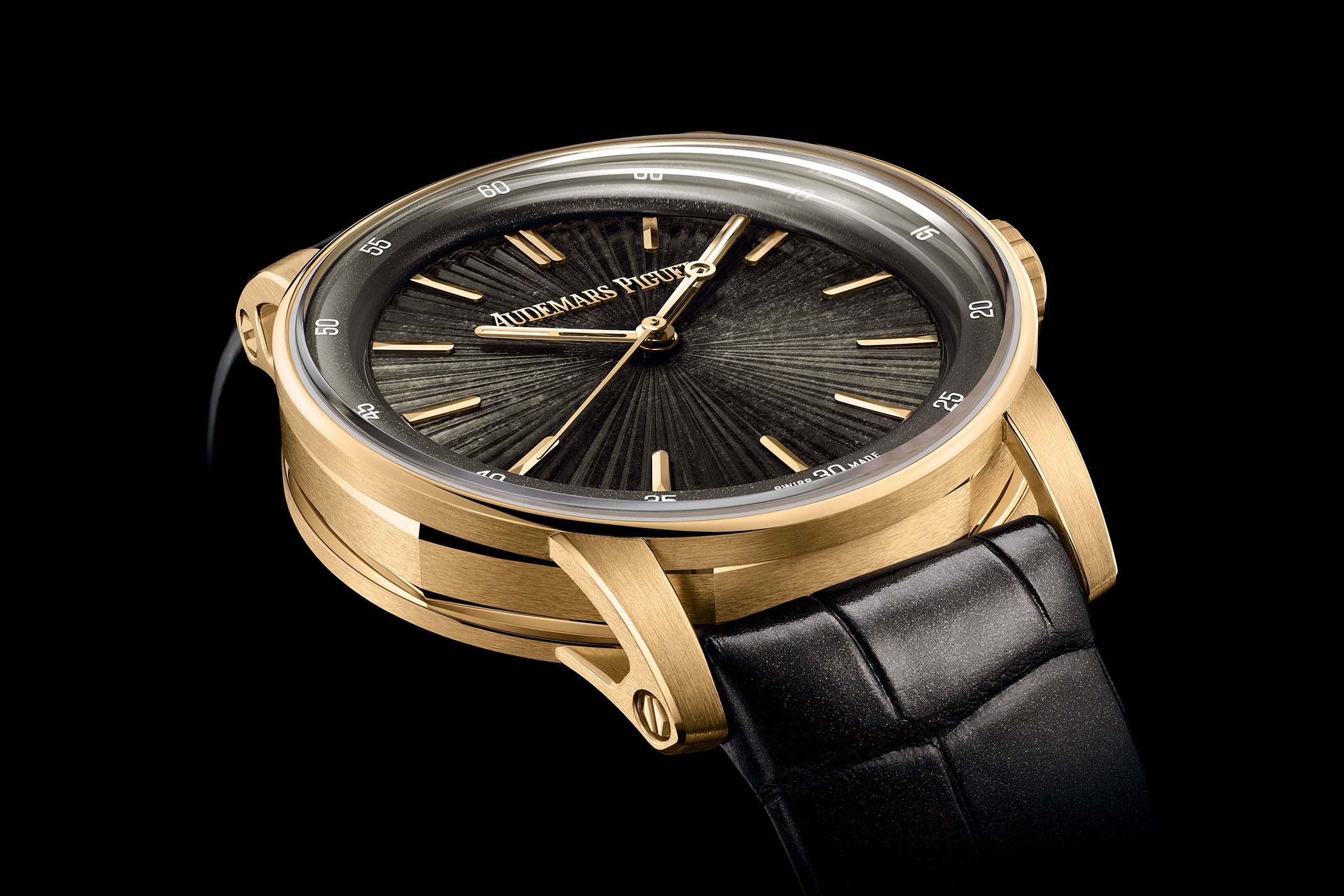
The Code 11.59 (ref. 26395BC) takes the opposite visual approach from the Royal Oaks. Its 41mm white gold case, 13.6mm thick, has a case middle that is entirely polished, and the smoked sapphire dial partially reveals the calibre 2953 beneath it. This is where dial design and acoustic engineering intersect most directly: an open, see-through dial construction has to coexist with a soundboard-based chiming system without one undermining the other. AP uses galvanic growth to add texture to the minutes track and the rim around the small seconds, giving the open layout some structure rather than leaving it a bare window onto the movement. White gold baton hands and hour markers, without luminescent fill, sit against the darkened background. Water-resistance is also rated at 20m, and the watch comes on a grey alligator strap with a white gold AP folding clasp.
The Movement Behind All Three
Calibre 2953 is a manually wound movement measuring 30mm in diameter and 6mm thick, built from 362 components with 32 jewels. It runs at 21,600 vibrations per hour with a 72-hour power reserve, and the minute repeater is activated by a slider on the left side of the case — a detail that itself has to be integrated into the case middle without compromising the acoustic chamber behind it. Because all three watches share this exact movement, the differences in how each one sounds and feels in the hand come down almost entirely to case material, case construction, and how much of the dial is left open versus solid.
What This Means Going Forward
These three references demonstrate that Supersonnerie isn’t a single fixed formula applied identically across case materials and dial treatments. Titanium, pink gold, and an open-dial white gold construction each pose distinct acoustic and structural questions, and AP is continuing to test the system’s flexibility a decade after its introduction. For now, all three are available through Audemars Piguet directly, with no stated limits on production noted.