
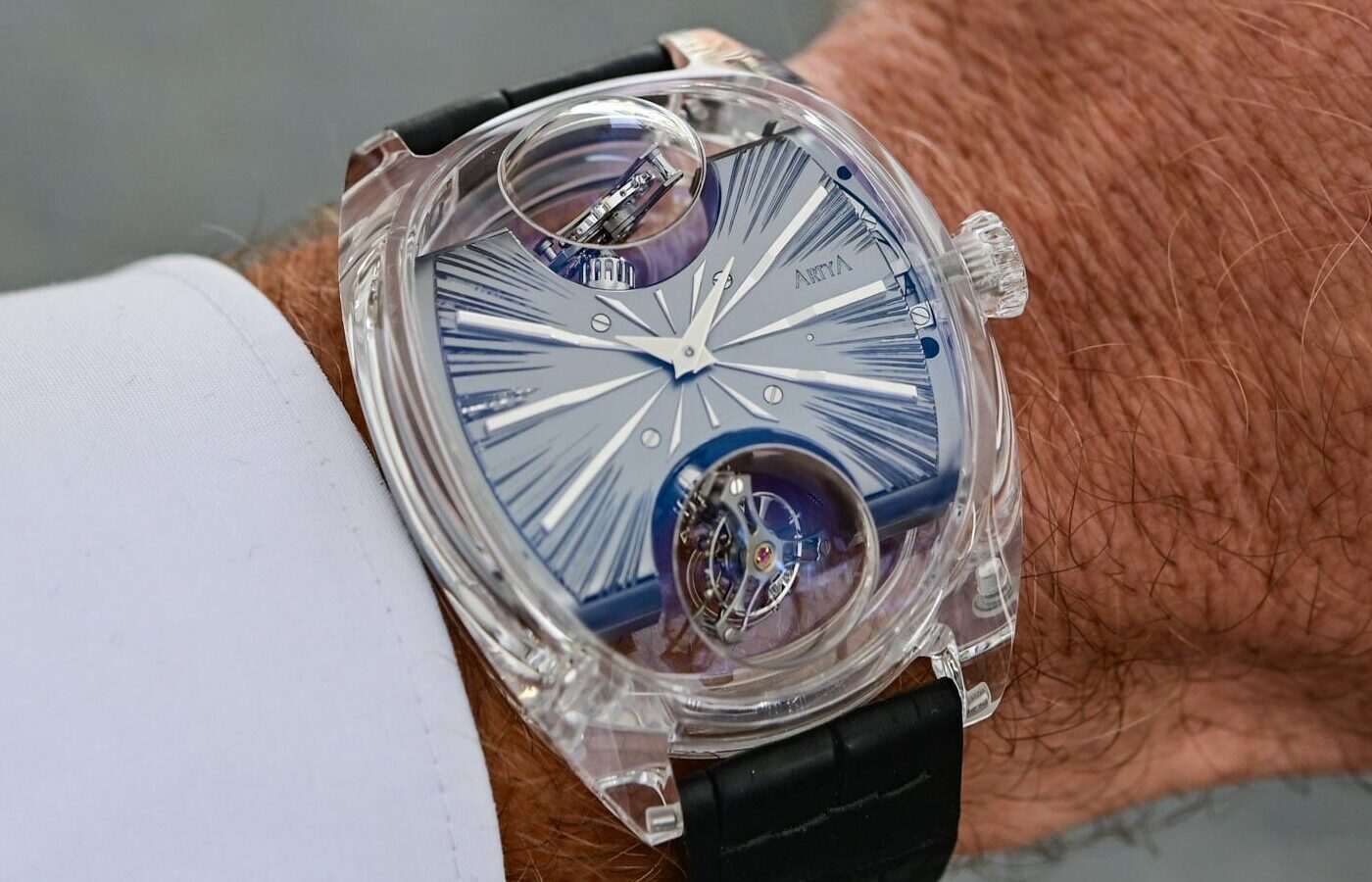
ArtyA has released a new version of its Complexity, the independent Geneva brand’s double inclined tourbillon watch, this time built around hand-finishing rather than mechanical display alone. Called the Complexity Métiers d’Art, the piece keeps the same world-first architecture introduced earlier this year: two inclined tourbillons, positioned at 12 and 6 o’clock, connected by a differential. What changes here is the treatment of every visible surface, inside and out, through engraving, hammering, shot blasting, perlage and hand-polished bevelling.
The case itself is the starting point for understanding why this watch looks the way it does. It’s cut from a solid block of synthetic sapphire, measuring 42mm by 48mm and 13mm thick, with a triple-concave construction that ArtyA says follows the wrist’s contours despite the mechanical complexity packed inside. That case shape is not decorative. It exists because the movement demands sapphire domes at 12 and 6 o’clock to clear and magnify the two tourbillon cages, which sit at opposite poles of the dial rather than in a conventional single lower position. The result is a case that reads as asymmetric by necessity: the geometry of the movement dictates the geometry of the crystal around it.
Producing that shape in solid sapphire is not a quick job. ArtyA states the case geometry requires more than 120 hours of diamond machining and over 140 hours of polishing. Sapphire’s hardness makes it resistant to conventional case-forming techniques, so the triple-concave profile, the domed apertures, and the transparent construction all have to be worked through abrasive processes rather than stamping or casting. Even the crown is faceted crystal, carrying the transparent theme down to a component most watches would finish in metal.
Because the case is transparent, it doesn’t hide the mechanism, it frames it. The two sapphire domes act almost like windows built directly into the sculptural form of the case, rather than flat display backs bolted onto a conventional middle case. That’s a structural consequence of housing two inclined regulators instead of one flat tourbillon: the case has to rise and dome in two separate places to give the Conillon cages room to rotate through their conical paths.
Dial Design Built Around Engraving, Not Symmetry
The dial follows the same logic. Its base is finely sandblasted, then hand-engraved with a burin that carves individual radiating scratches across the surface. Applied indices carry hand-polished bevels, with flanks drawn using a carbon buff and upper faces left sandblasted so they integrate with the textured dial rather than compete with the engraving. There’s no conventional dial plate running edge to edge here; the two tourbillon apertures interrupt what would otherwise be a continuous surface, forcing the engraved pattern to work around two focal points rather than radiate from a single center.
The Movement: Calibre Complexity-01
Power comes from the proprietary manual-winding Calibre Complexity-01, developed with Purtec Sarl in Vallorbe. Its defining feature is the pair of Conillon regulators, each following a conical rather than cylindrical path, intended to help compensate for gravitational effects as the watch moves through vertical positions. The two cages rotate in opposing directions, each completing a full turn in 30 seconds, while a differential distributes energy between them and averages their rates. The movement runs at 21,600vph, holds a 50-hour power reserve, and is built from 287 components across 44 jewels. Measured on its own, the calibre is 37.5mm wide and 30mm long, growing to 38.2mm with the tourbillons fitted; height runs 9.05mm, or 14.1mm including the tourbillon assemblies.
For this Métiers d’Art edition, that movement receives the same finishing intensity as the case. Upper surfaces are hand shot-blasted, lower surfaces are hand-hammered to create relief, and every angle is bevelled and polished by hand. The mainplate recesses around the differential carry hand perlage, flanks are carbon-buffed to match the dial treatment, and a polished moulding on the centre bridge frames the mechanism. Black rhodium plating darkens the background so the polished edges and textured surfaces stand out against it. A numbered plate is hand-engraved, tying each piece to its place in the production run.
Availability
The watch is worn on an integrated rubber strap with an ArtyA folding clasp. The sapphire-cased version is limited to nine individually numbered pieces, available by order through ArtyA Genève and official retailers; a pigeon-blood ruby version is also offered. For a brand built on unusual mechanical premises, the Complexity Métiers d’Art is a direct test of how far hand-finishing can be pushed on a case material, and a movement architecture, that most workshops would already consider difficult enough to produce plain.