
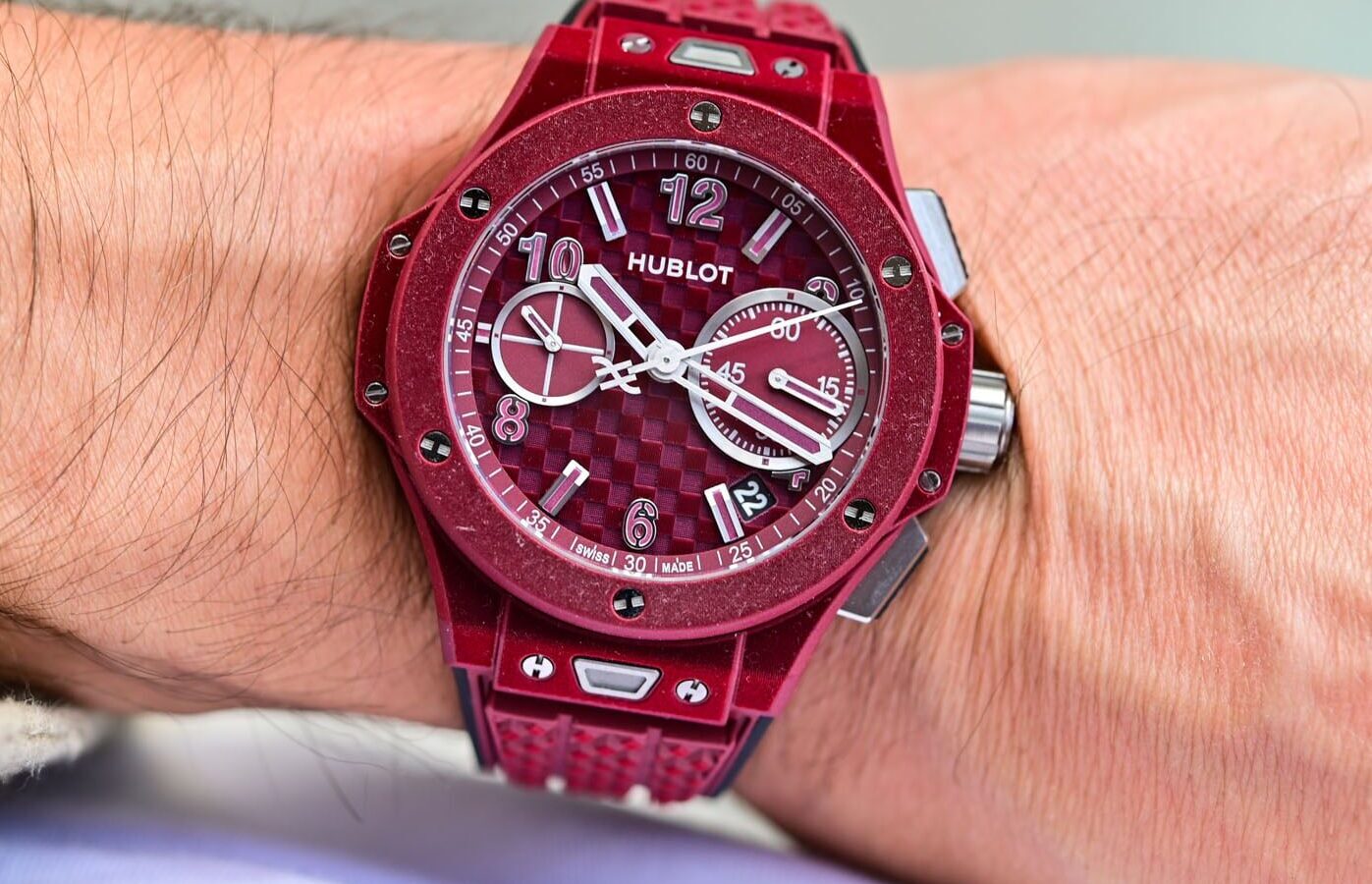
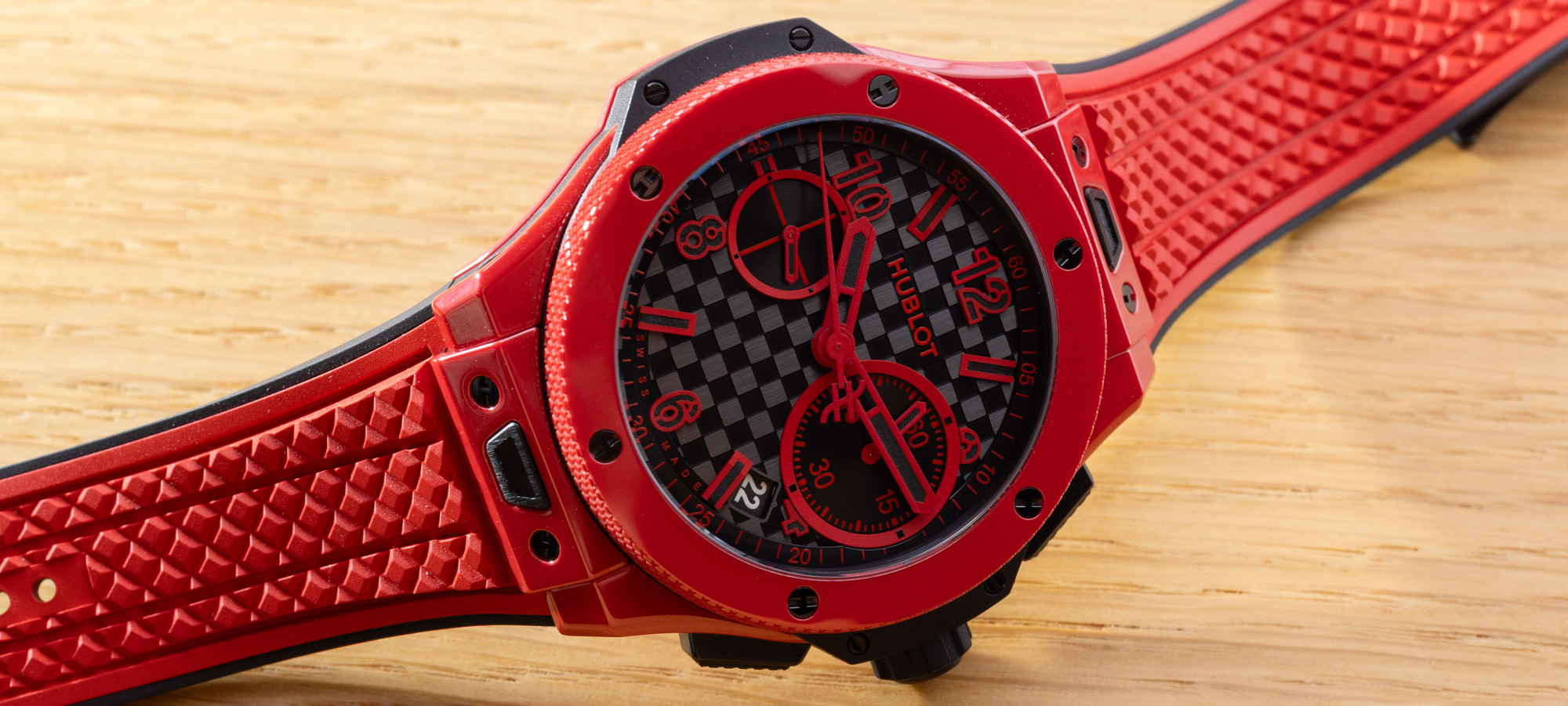
Hublot has introduced the Big Bang Original Soft Touch, a pair of 43mm chronographs, in All Red and All Black, that rework the case surface of the Big Bang Original through an overmoulded rubber compound rather than a conventional coating. The compound is engineered with a microscopic textured structure, described as composed of thousands of fine micro-elements, that produces a soft, velvet-like feel across the case, bezel, dial and strap. This is not paint or spray finish sitting on top of the metal. It is built into the physical construction of the watch through a dedicated overmoulding process using custom-engineered tooling.
Case Construction and Where the Rubber Compound Sits
The case itself remains titanium, 43mm in diameter and 13.2mm thick, with 100m water resistance and the layered Big Bang architecture that has defined the line: lateral bumpers, a bezel secured by six H-shaped titanium screws, a screw-down crown and rectangular pushers. What changes is the surface treatment applied over and around that structure. The rubber compound sheathes the case and caseback, wraps the bezel, covers the screw-down crown and pushers, and extends to the dial and strap. Sapphire crystal with anti-reflective treatment on both front and back remains untouched by the texture, which makes sense given the need for optical clarity there. The One-Click strap-change mechanism, integrated into the trapezoidal buttons at the top and bottom of the case, is retained as well, so the quick-release function that Hublot patented for its straps continues to operate normally beneath the new surface finish.
The engineering rationale given for choosing overmoulding over a surface spray is durability. A sprayed or coated finish can wear thin or degrade with repeated handling and exposure; integrating the texture directly into the rubber during moulding is meant to keep that tactile quality intact through the life of the watch. Whether that holds up to years of daily wear will depend on real-world use, but the manufacturing logic behind the decision is sound: a moulded-in texture is part of the material itself, not a layer sitting above it.
Dial Layout and Finishing
The dial is also rendered in the rubber compound and carries a raised, stamped pattern that emulates carbon fibre, described as a chequered or checkerboard-style print. Numerals follow the applied, stencil-like Arabic style associated with the original 2005 Big Bang, filled with Super-LumiNova, and the hands carry matching luminescent inserts. Layout is straightforward: a small seconds subdial at 9 o’clock, a 60-minute chronograph counter at 3 o’clock, both framed and snailed, and a date window positioned between 4 and 5 o’clock. The central chronograph seconds hand carries an “H” counterweight, a detail that ties the dial furniture back to Hublot’s established design vocabulary even as the surface material shifts underfoot.
Colour references are historical rather than arbitrary. The All Black recalls Hublot’s 2006 monochromatic black model, while the All Red points to the brand’s 2018 Red Ceramic watch, itself a landmark in coloured high-tech ceramic production. Neither colourway is new to Hublot’s design history, but applying them through a textured rubber compound rather than polished ceramic or metal is the actual departure this release represents.
Movement and Mechanical Specification
Powering both models is the HUB1280 Unico, an in-house automatic flyback chronograph with a column wheel, built from 354 components and running on 43 jewels. It operates at 28,800vph, or 4Hz, with a silicon escapement and delivers a 72-hour power reserve. The rotor is openworked tungsten. This is the same calibre family associated with Hublot’s Unico chronograph architecture, and its presence here confirms that the Soft Touch treatment is a surface and materials exercise layered onto an existing, proven movement platform rather than a mechanical redesign.
The strap continues the material story with the same velvety red or black rubber compound, finished in Hublot’s classic lozenge pattern and fitted to a titanium deployant clasp. Because the One-Click system is built into the case rather than the strap alone, owners can swap straps without tools, a practical feature that remains functionally unchanged despite the new surface finish surrounding it.
Where This Sits in the Line
Reference numbers for the two models are 431.RXR.2770.RX.VEL for the All Red and 431.RXN.2740.RX.VEL for the All Black, both joining Hublot’s permanent collection rather than arriving as limited runs. That distinguishes the Soft Touch pair from the sort of numbered limited editions Hublot has used elsewhere in the Big Bang Original range; these are intended as ongoing catalogue models. For a design studio audience, the interesting takeaway is procedural: Hublot has treated tactile surface engineering as a repeatable manufacturing process suitable for continuous production, not a one-off finishing experiment reserved for a short-run special. That positions overmoulded, textured rubber as a material direction the brand may plausibly extend to other case shapes in future collections.