
Louis Vuitton has confirmed that the Tambour Spin Time, previously issued only as limited editions, is now a permanent line of five references. The announcement, made public on September 8, 2026, follows the 2025 Tambour Taiko Spin Time limited editions and effectively locks the jumping-cube complication into two case sizes, 39.5mm and 42.5mm, spread across three different in-house calibers. For a mechanism this visually demanding, that shift from limited run to standing catalogue changes how the case and dial actually have to perform over years of daily wear, not just for a single collector’s cycle.
The complication itself, developed originally by Michel Navas and Enrico Barbasini and refined since by La Fabrique du Temps, uses 12 rotating cubes connected to the movement by arms. Each cube carries four faces: two show hour numerals, two hold a neutral background that blends into the dial when not in use. At the top of the hour, the current cube snaps 90 degrees and disappears while the next cube rotates into view with a contrasting background. A central hand tracks the minutes. It’s a mechanical restaging of the jumping hour in three dimensions, and it was reportedly inspired by the mechanical flap-panel departure boards once common in airports.
Case Design and Proportions Across the Line
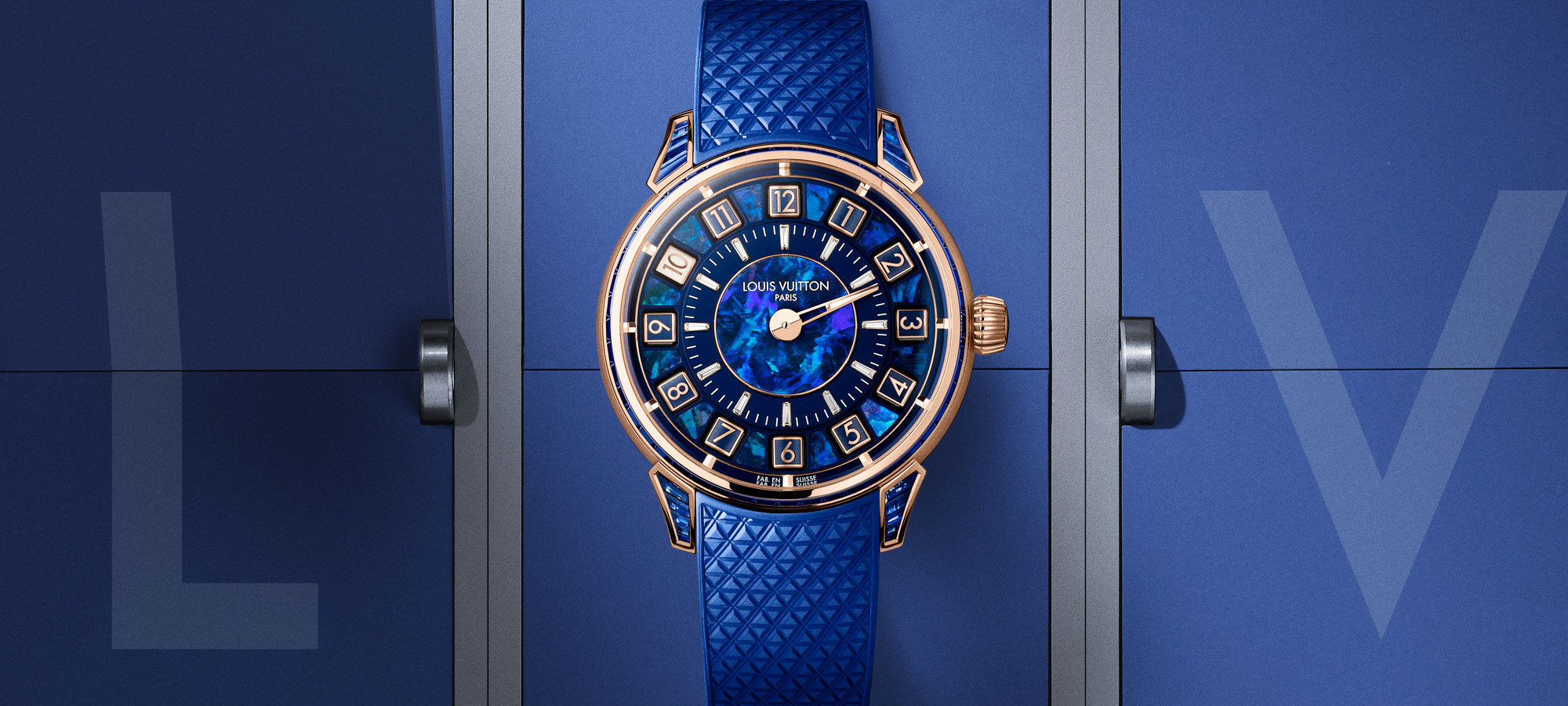
Two entry points anchor the range at 39.5mm x 12.15mm: the Tambour Spin Time Green in 18k white gold, and the Tambour Spin Time Australia’s Opal in 18k rose gold with blue sapphires set into the bezel and lugs. Both retain the closed-dial format of the original Spin Time concept, with the cubes displaying numerals directly against the dial rather than through an open-worked structure. That compact case size, and the tight 12.15mm case height, keeps these two models wearable in a way the open-worked pieces are not.
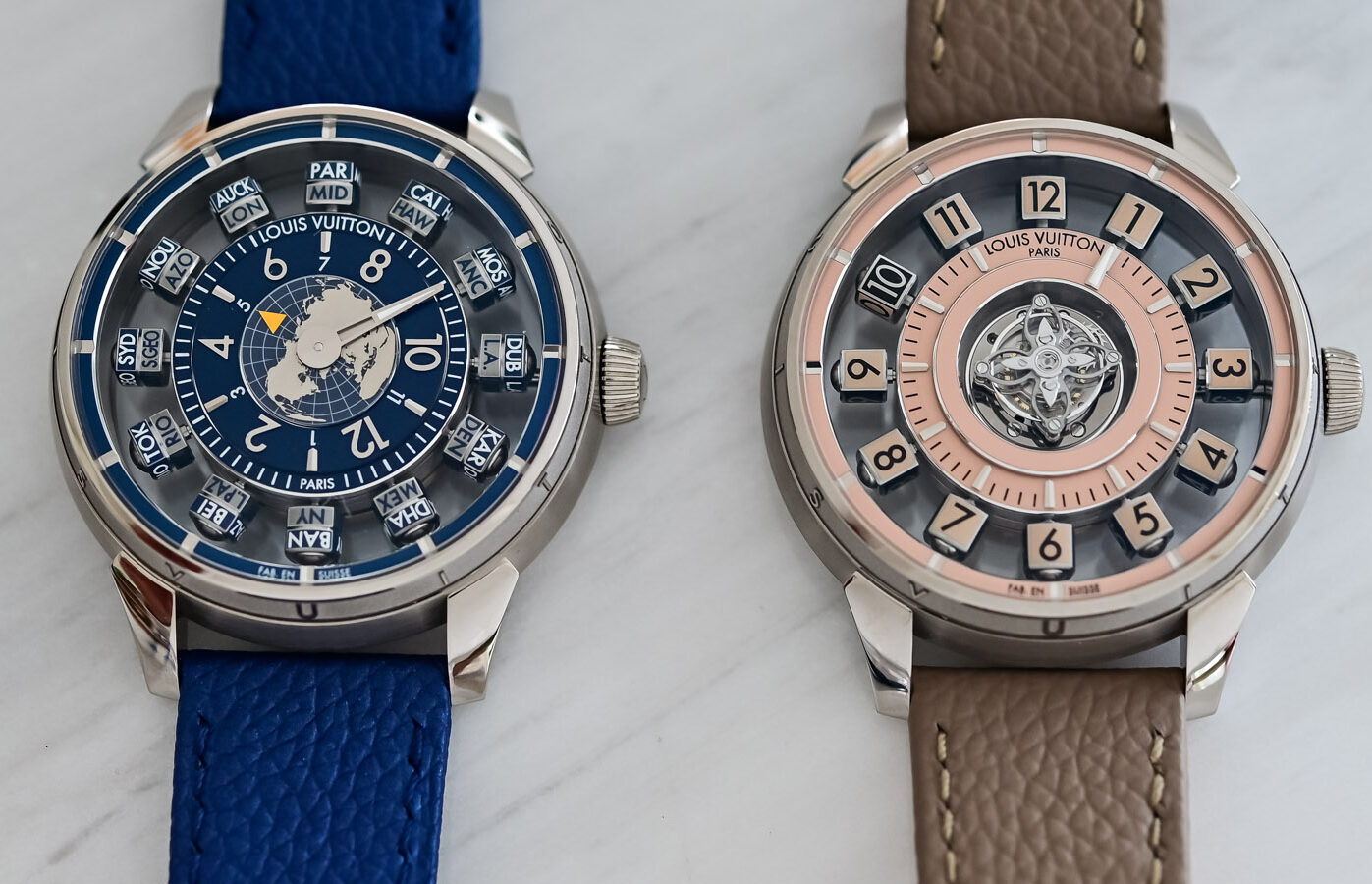
The three Spin Time Air models step up to 42.5mm x 12.45mm cases, a jump of 3mm in diameter and 0.3mm in height over the closed-dial pair. That increase isn’t cosmetic. Because these dials are open-worked, with the movement suspended at the center and the cubes appearing to float rather than sit against a solid backdrop, the case needs more real estate to keep the mechanism visible and the twelve-letter “Louis Vuitton” bezel engraving legible around the perimeter. The Tambour Spin Time Air Blue, in white gold with a blue dial, replaces numeral cubes with rotating blocks that spell out the brand name letter by letter, with the letter corresponding to the current hour picked out in a different color. It’s a legibility trade-off: reading the hour now means parsing which letter is highlighted rather than reading a number outright, a shift that only works because the open case gives the eye more room to isolate that single illuminated block.
Complication Variants and Movement Architecture
The Tambour Spin Time Air Antipode Blue, also in white gold with a blue dial featuring a globe motif, repurposes the rotating-block mechanism as a worldtimer. Each block face carries two city names on opposite sides of the globe, sharing the same 12-hour value but split between AM and PM. Rather than the cubes indicating the wearer’s local hour, that job moves to a central indicator, freeing the rotating display to cycle through 24 time zones. It runs on Caliber ST12.01, distinct from the ST13.01 found in the two closed-dial models and the Air Blue.
At the top of the range sits the Tambour Spin Time Air Flying Tourbillon Salmon, cased in 950 platinum with a salmon dial, the only reference in the lineup not built in gold. Here the rotating cubes still display the hours, but the center of the dial is given over to a flying tourbillon, with the minute hand relocated to travel around the outer edge of the tourbillon aperture instead of crossing over it. It uses Caliber LFT ST05.01. Across all three movements, the specification holds steady: automatic winding, a 4Hz beat rate, and 45 hours of power reserve, giving the range mechanical consistency even as the display architecture changes from model to model.
Water resistance splits along the same line as case size: the 39.5mm closed-dial pair rates to 100 meters, while the 42.5mm Air models drop to 50 meters, a predictable consequence of the additional casebacks and crystal openings needed to expose the movement. Strap choices follow the same logic, with rubber on the smaller pair and calf leather on the Air trio, reinforcing that the compact references are built for more active daily wear while the open-worked pieces lean toward dress use.
With five references now standing as ongoing production rather than a limited drop, the Spin Time’s jumping-cube display gets tested under a different set of conditions: daily winding, repeated pocket and wrist contact, and the scrutiny that comes with a watch expected to perform reliably for years rather than simply photograph well at launch.