
The Berneron Mirage 38 Miroir arrives as a considerably reworked take on Sylvain Berneron’s asymmetric dress watch, built around a new gold calibre described by the brand as a mirrored interpretation of the movement that defined the original Mirage. First deliveries are scheduled for October 2027, with Series A production set at 36 pieces per colour per year over a ten-year run. The case measures 38mm in length, 34mm in width, and just 7mm thick, with a 42mm lug-to-lug, crafted entirely in 18k gold in either white or yellow.
A Case Shaped by the Movement, Now Inverted
Berneron’s original premise was to let the movement dictate the case shape rather than fitting a movement into a predetermined silhouette. The Mirage 38 Miroir keeps that sculptural, irregular outline but pushes the concept into new territory by mirroring the movement construction itself. The case retains a solid caseback, while the front is topped with a hesalite crystal treated for improved scratch resistance rather than sapphire. At 30mm long, 28mm wide and just 2.83mm thick, the new Calibre 283 sits within that compact 38 x 34mm envelope without needing to hide anything beneath a conventional dial.
From Calibre 233 to Calibre 283
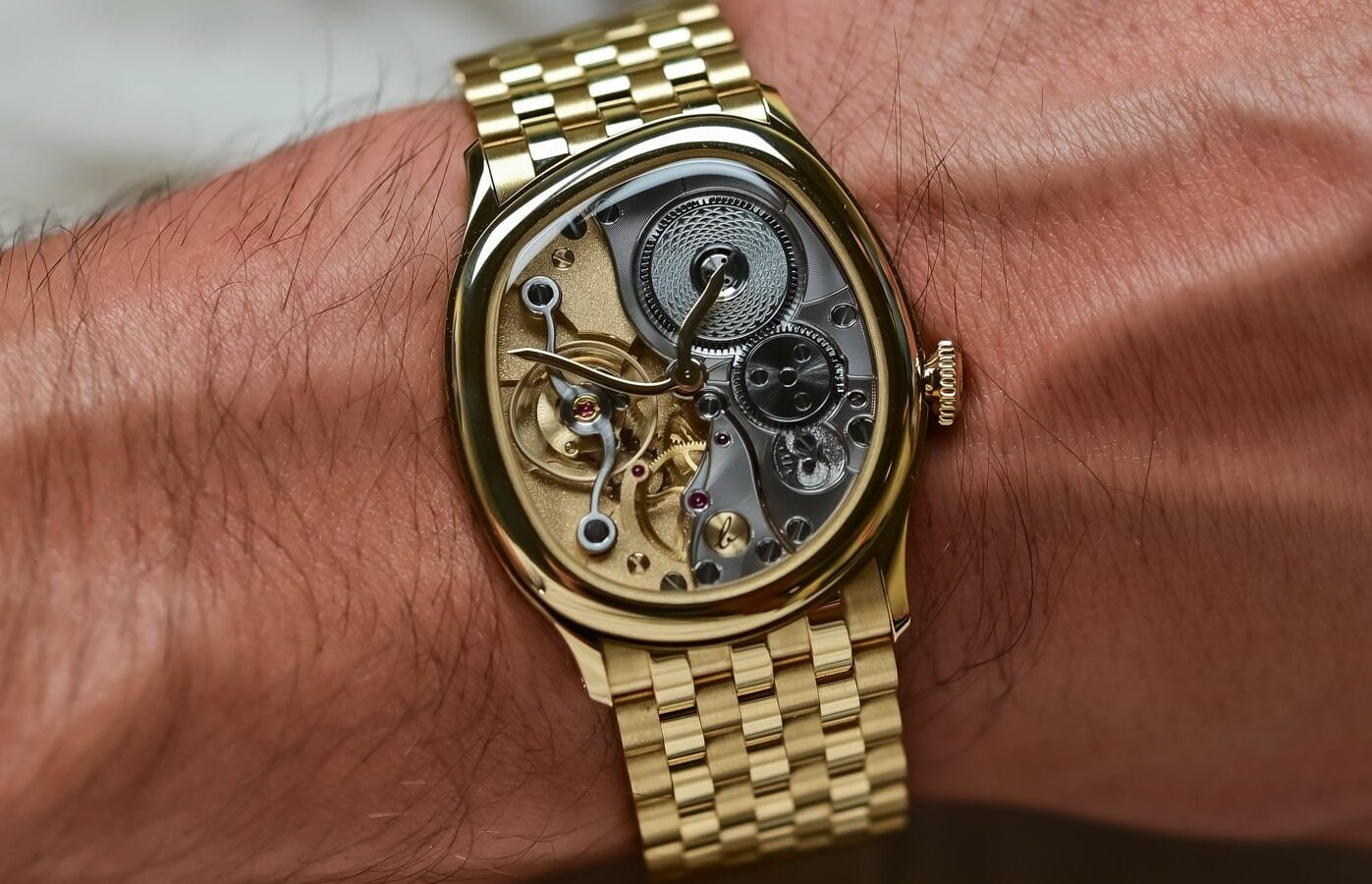
The naming is deliberate: Calibre 283 as a mirrored counterpart to Calibre 233. This is not a simple flip of the movement to show its reverse, nor is it standard skeletonisation of an existing plate. Only about one-fifth of the original 233’s components carry over, largely the barrel and winding assembly, with everything else redesigned or newly engineered. The result is effectively a new movement that reflects the architecture of its predecessor while restructuring it so that the mainplate and bridges themselves become the visual interface for telling time.
Different levels, steps, and split lines cut into the mainplate and bridges create the visual reference points a wearer needs, with a sector guilloché pattern standing in for hour markers. Curved gold hands read the time, with the hour hand positioned above the minutes, an inversion of the conventional stacking order. Berneron also dropped the running seconds sub-dial from this configuration; instead, the seconds wheel itself functions as the running indicator, folding another mechanical element directly into the composition rather than adding a separate display.
Movement Architecture and Finishing
Calibre 283 carries 135 components and 17 jewels around a free-sprung balance running at 21,600 vibrations per hour, driven by two barrels for a stated 72-hour power reserve. It uses a traditional Swiss lever escapement. Finishing spans guilloché, anglage, colimaçonnage, laser engraving, cerclage, traits tirés and nuagage, applied not as a showcase of technique alone but as functional detailing that helps the eye navigate the openworked layout. Components such as wheel spokes and the balance bridge are shaped to match the case’s broader sculptural language, tying the mechanical guts to the exterior form rather than treating them as separate design problems.
Strap, Bracelet and Wearability
Fittings extend the all-gold approach throughout: the buckle and spring bars are solid gold as well. On the standard configuration, the watch is fitted to a 20-16mm Barenia leather strap, keeping the piece within the proportions of a traditional dress watch despite its unconventional case geometry. An optional integrated-looking 20mm multi-link solid-gold bracelet, developed in-house by Berneron, is also available in white or yellow gold, shifting the watch’s character toward something closer to fine jewellery while staying faithful to the sculptural case design. Water resistance is rated to 30 metres, consistent with a piece intended for dress wear rather than daily rough use.
What distinguishes the Mirage 38 Miroir from the standard Mirage is the extent to which the movement’s construction has been rebuilt specifically to double as the dial, rather than simply being visible through an aperture or exhibition back. The mirrored Calibre 283 asks the mainplate, bridges and wheel train to perform a dial’s job of marking hours and showing motion, using stepped surfaces and finishing techniques as the reference points a wearer actually reads. For a market that already knows Berneron’s movement-first case philosophy, the Miroir represents a specific engineering extension of that idea, with deliveries beginning October 2027 and production capped at 36 pieces per colour annually across a ten-year run.