
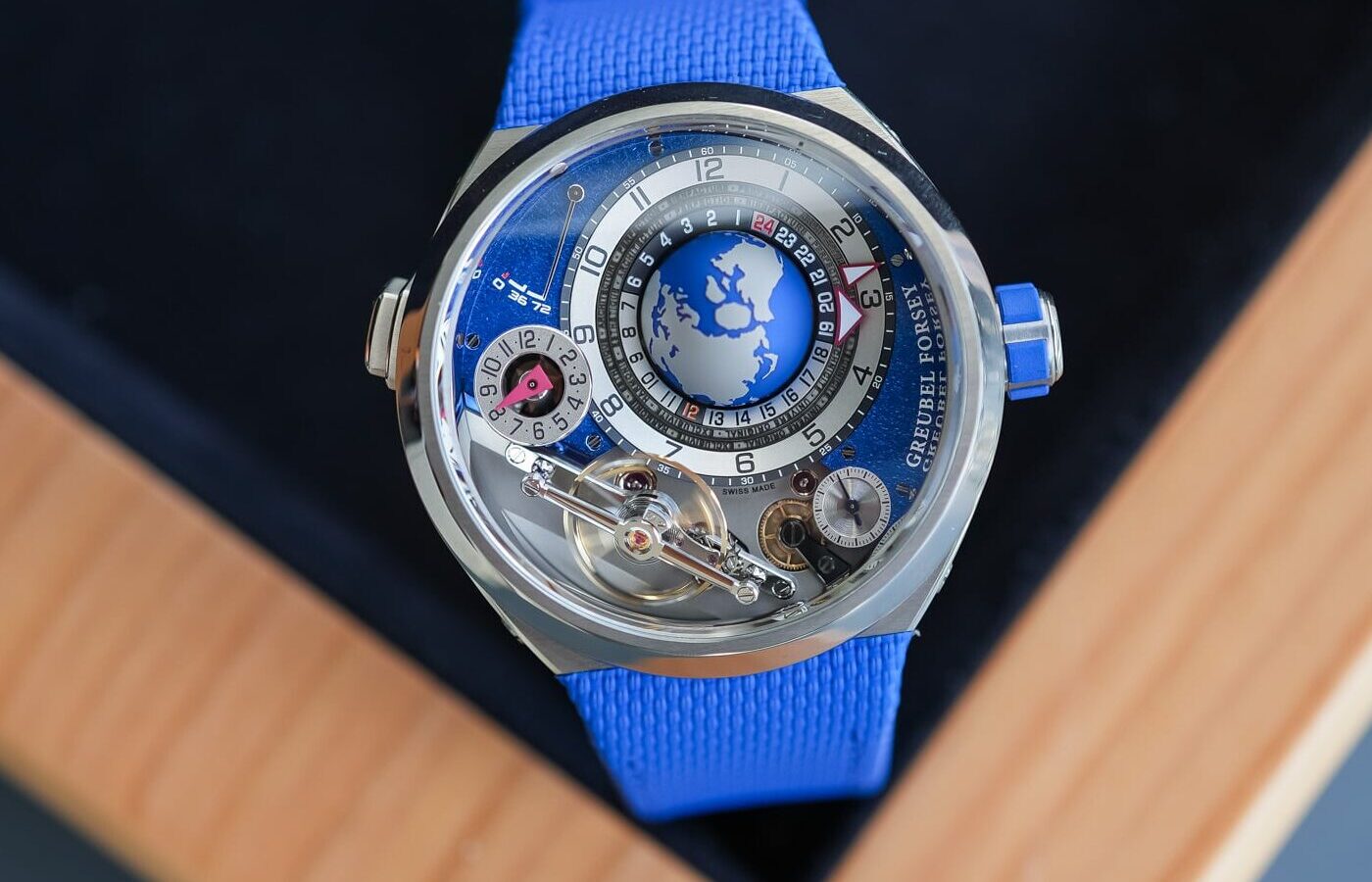
Greubel Forsey has introduced a new version of its GMT Balancier Convexe, presented in blue during Geneva Watch Week, with a titanium case reduced from 43.5mm to 42.9mm in caseband diameter and from 46.5mm to 44.9mm at the bezel. That is a 0.6mm reduction in caseband and a 1.6mm reduction across the flared bezel. Thickness remains unchanged at 15.1mm, or 17.6mm including the domed sapphire crystals on both dial and caseback sides. The watch is limited to 22 pieces.
The reduction sounds modest on paper, but it arrives alongside an added complication rather than a simplification. This edition introduces a power reserve indicator on the dial, a function that required 73 additional components, positioned at 11 o’clock with an elongated hand reading against a 72-hour scale in the limited space to the left of the rotating globe. Fitting more into a smaller case is the actual engineering story here, and Greubel Forsey addressed it by diminishing the overhang of the flared bezel and reworking the internal seals. The trade-off is a drop in water resistance to 50 metres.
Case Design and the Convexe Profile
The case construction follows the Convexe language established by the line: a bezel wider at its centre than at its edges, curving to match the domed sapphire crystal above it. There are no lugs. The caseband and bezel surfaces are hand-polished and straight-grained, and the curved bezel profile is what allows a case of this stated diameter and thickness to sit flush against the wrist rather than perching above it. Monochrome Watches noted that on a 16.5cm wrist, the watch did not read as oversized despite the specifications. The titanium crown carries blue rubber grips matching the dial’s colour scheme, and an engraved rectangular pusher on the case flank adjusts the GMT indicator in one-hour jumps, simultaneously advancing the rotating globe.
The Inclined Balance Wheel and Rotating Globe
Unlike the original 2011 GMT, which used an inclined 24-second tourbillon and required a case protrusion with a viewing window on the flank to accommodate it, this Convexe-cased model replaces the tourbillon with an inclined balance wheel set at 30 degrees, running across the dial from 6 to 8 o’clock. The balance beats at 3Hz (21,600vph), comprises 59 parts, has a diameter of 12.6mm, and is held by a mirror-polished steel bridge. Visually it reads with as much presence as a tourbillon cage, appearing to float below the dial plane, and the inclination itself is a Greubel Forsey innovation intended to improve chronometric performance by varying the balance’s orientation relative to gravity.
The rotating titanium globe remains the dial’s central event, with relief-engraved continents and a complete 24-hour rotation performed in real time. It sits within a deep, amphitheatre-like well, and the bridges surrounding it are finished in a frosted texture in the same blue as the globe’s oceans, diffusing light across the surfaces rather than reflecting it sharply. A 24-hour chapter ring frames the globe, giving an intuitive read of day and night across time zones, while the second time zone is displayed conventionally on a gold 12-hour sub-dial at 9 o’clock, shown with a solid red arrow-shaped hand. A gold small seconds counter at 5 o’clock uses a blued steel hand, and the hour and minute hands are red, arrow-tipped, with luminescent inserts. Internally, the titanium flange walls are mirror-polished to help direct additional light onto the dial’s recessed elements.
Movement Architecture
Power comes from a patented manual-winding calibre built from 496 parts and running on 72 jewels, measuring 37.8mm by 13.8mm. Two series-coupled fast-rotating barrels deliver a 72-hour power reserve across the hours, minutes, small seconds, GMT function, rotating globe, and day/night indication. For readers wanting universal time, the caseback is engraved with 24 reference cities set against a 24-hour scale, with an inner ring marking daylight saving time.
The strap is a hand-sewn, textured blue rubber, available with text in relief, fitted to a titanium folding clasp; a titanium bracelet can be ordered as an alternative. This edition follows a darker-coloured version introduced at Dubai Watch Week the previous year, and represents the same architecture applied with revised proportions and one new function. For a maker working at this level of mechanical density, the more instructive detail may be the water-resistance reduction to 50 metres, a reminder that shrinking a case is rarely free of consequence once a movement’s component count keeps growing.