

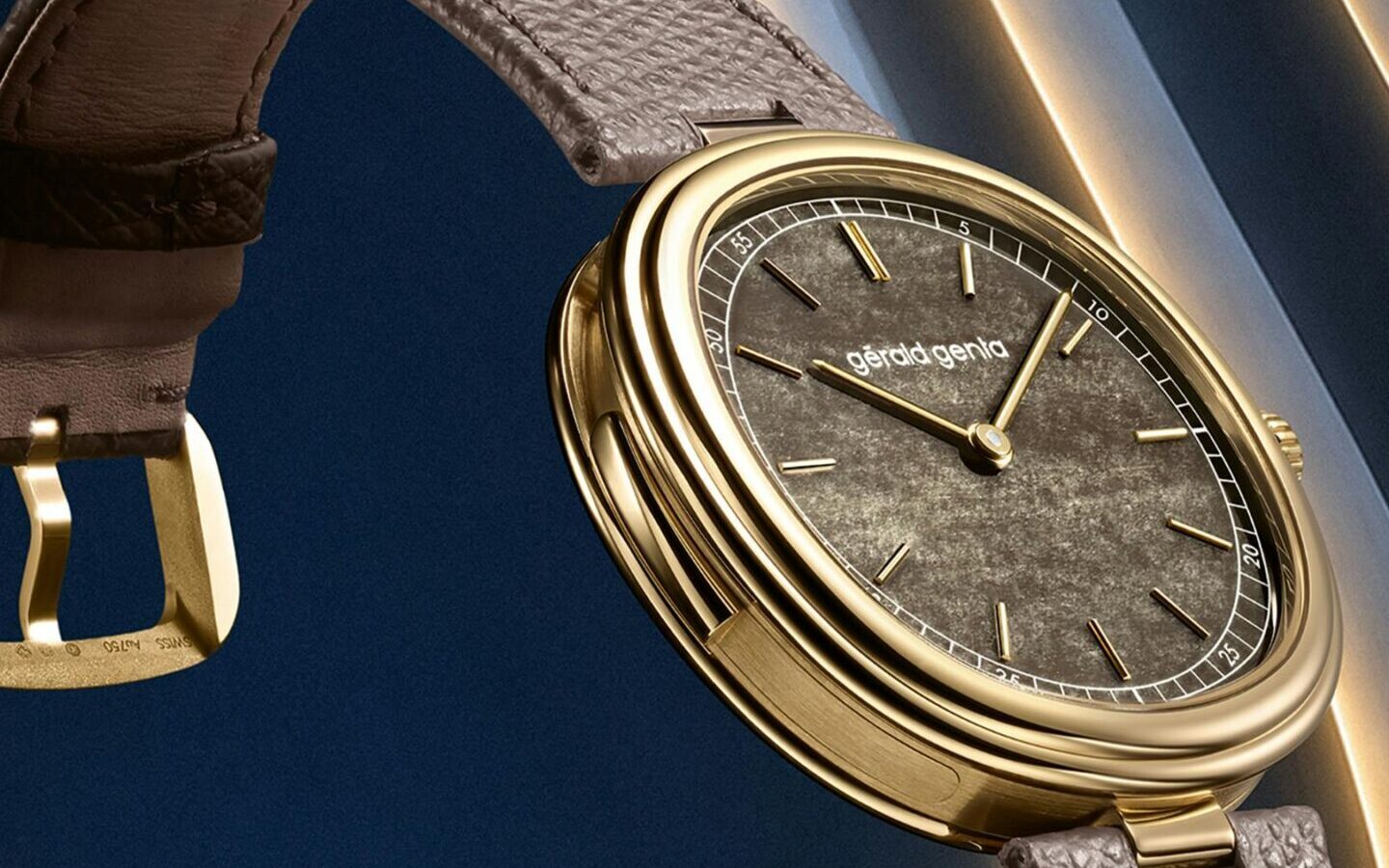
Unveiled at Geneva Watch Days in September 2026, the Gérald Genta Geneva Minute Repeater Golden Obsidian follows the earlier Geneva Minute Repeater Black Onyx and makes one decisive material change: the dial is now volcanic obsidian glass rather than onyx. That substitution sounds like a cosmetic adjustment. It is not. Obsidian and onyx share a superficial visual kinship — both are dark, both are hard — but their physical structures are entirely different, and those differences ripple through the watch’s acoustic behavior, its light interaction, and the logic of its case construction.
The Case as an Acoustic Instrument
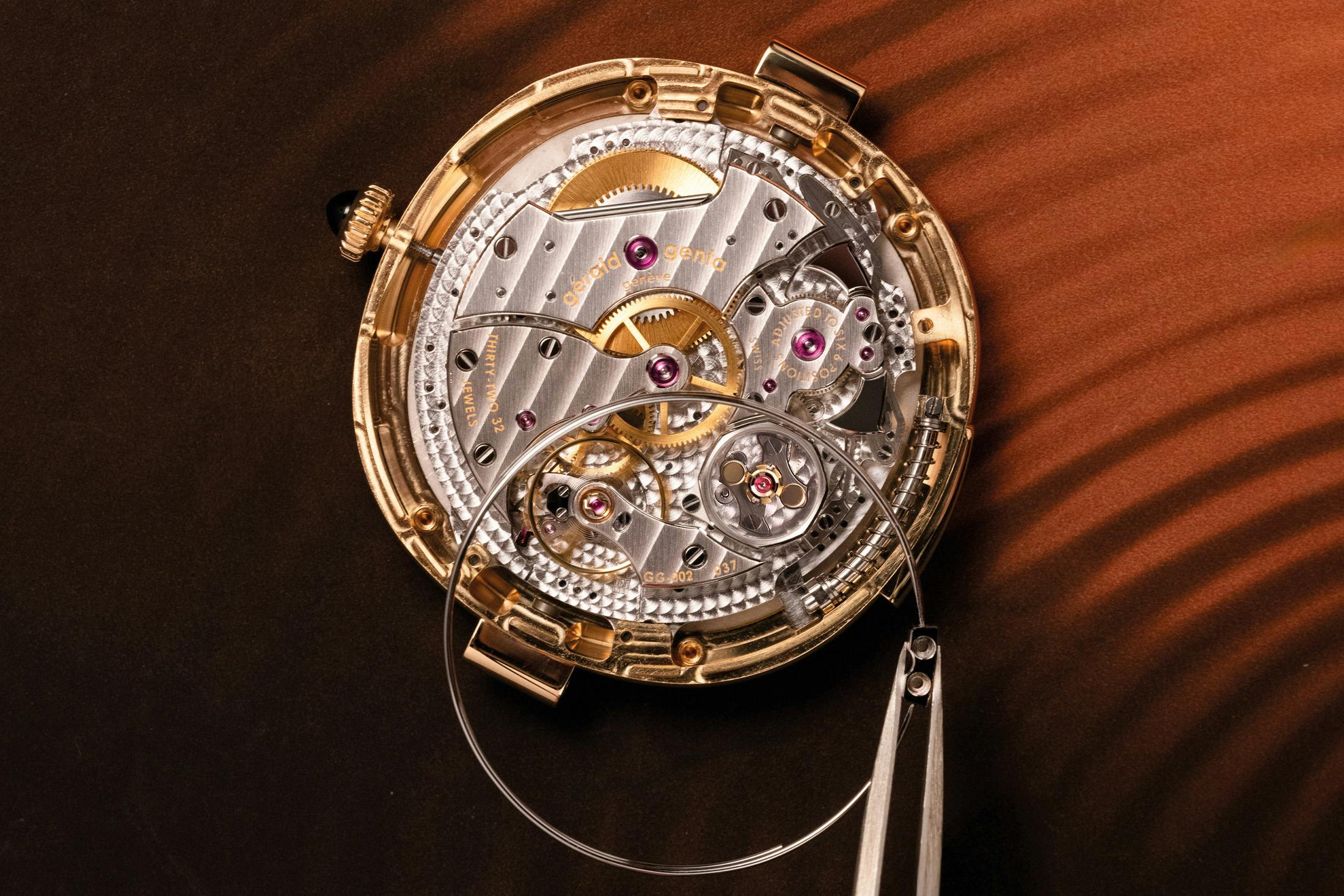
The 40mm case is cast in 3N yellow gold, a material choice the Maison makes deliberately for acoustic reasons. Yellow gold transmits sound with what the brand describes as greater warmth and purity compared to other case metals, and the entire architecture of this particular case has been engineered around that property. The case is 9.60mm thick — not generous by contemporary standards, but every fraction of that depth has been accounted for. The walls taper to just 0.6mm at the thinnest point. The bezel and caseback have been hollowed internally with circular drilling to reduce mass and resistance, allowing the chime to propagate through the case structure rather than being dampened by it.
This level of case reduction is genuinely difficult to execute in gold. The metal has to be machined with enough precision that the wall remains structurally sound at 0.6mm while still contributing to resonance rather than absorbing it. The case design was handled by Matthieu Hegi, Artistic Director of La Fabrique du Temps Louis Vuitton, who calibrated both the overall thickness and the internal geometry specifically to serve the acoustic performance of the complication. The collaboration between case architecture and chime quality has a direct precedent in the Maison’s own history: Gérald Genta worked closely with his Master Watchmaker Pierre-Michel Golay — whose background included a serious engagement with opera — to refine the acoustic character of his minute repeaters. That same priority is structurally embedded in this case.
Gadroons, Proportions, and the Cushion Silhouette
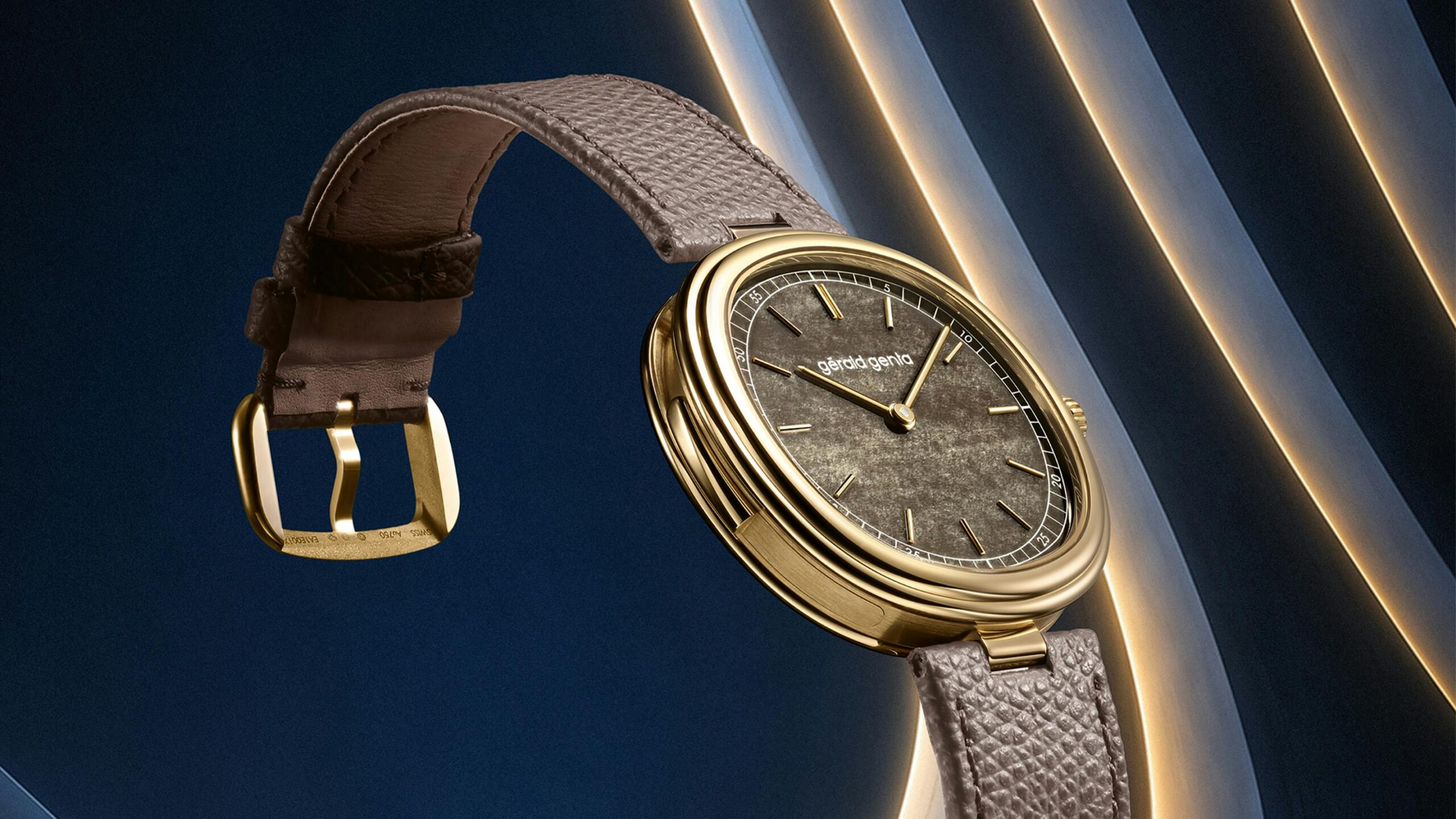
The case silhouette is the signature cushion shape of the Geneva Collection, a form that carries the Maison’s founding geometry forward from 1969. Smooth gadroon contours run along the case flanks, a detail that does real formal work: the gadroons break up the case’s surface area into defined ridges that catch light differently depending on the angle, giving the 40mm diameter more visual complexity than a plain polished surface would allow at that size. The proportions read as architectural without being rigid — the rounded corners and flowing transitions between surfaces give the case what the Maison calls a sculptural softness, a quality that matters practically when the watch is worn, since those contours sit against the wrist rather than pressing into it.
The Geneva Collection explicitly draws on two distinct influences: the technical precision of the Cabinotiers de Genève tradition and an Italian artistic sensibility that Genta brought to his case designs throughout his career. In this watch, those two threads are most visible in the tension between the engineered interior — hollowed, drilled, reduced to minimum viable wall thickness — and the exterior, which is fluid and decorative.
Obsidian: What the Material Actually Does
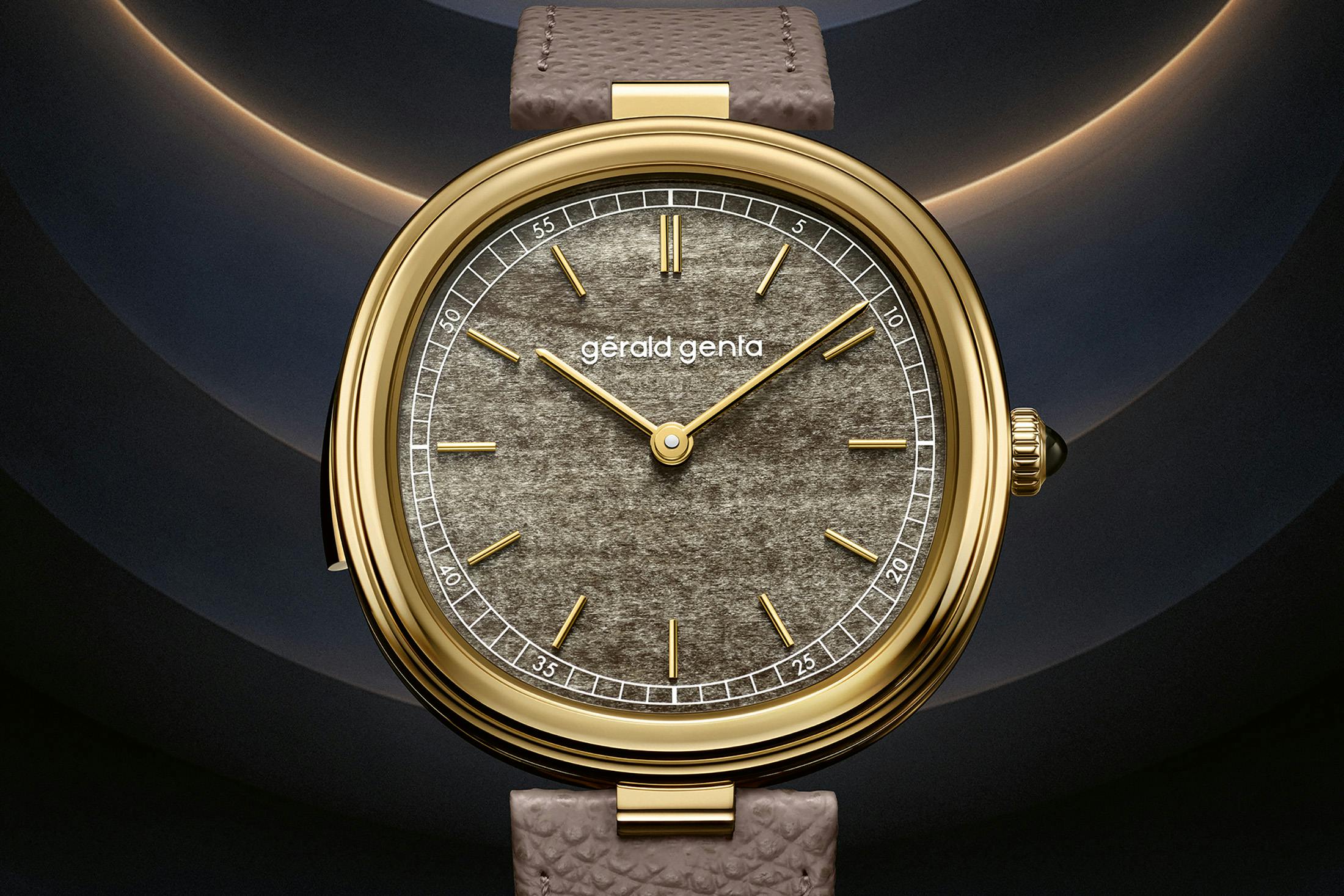
Volcanic obsidian glass is an amorphous material, meaning it lacks the crystalline structure that defines onyx. That structural difference has direct consequences for how the dial surface behaves under light. Onyx, as a banded silicate, has a degree of internal layering that can produce subtle variation across its face. Obsidian, being a natural glass formed from rapidly cooled lava, is more optically uniform — its surface reads as a single, continuous depth rather than a stratified one. The reflective quality is different: glassier, with a conchoidal fracture characteristic that gives obsidian its particular sheen when polished.
From a case construction standpoint, integrating a dial material with different hardness and thermal expansion properties than onyx requires adjustment at the fitting stage. Obsidian is brittle in a way that demands careful handling during machining and setting, and the tolerances at the dial edge — where the material meets the case — have to account for that brittleness. The visual result, a dial that reads as genuinely dark and glassy against the warm yellow gold of the 3N case, creates a contrast that onyx, with its slightly more matte character, would not replicate.
Acoustic Resonance and the Dial’s Role
A minute repeater dial is not acoustically neutral. Any material placed over the movement’s chiming architecture affects how sound travels through the watch. Obsidian, as a glass, has different damping characteristics than a stone like onyx. Glass transmits vibration more readily than many natural stones, which means the obsidian dial potentially contributes to rather than suppresses the chime’s projection. Combined with the hollowed case walls and the resonant properties of the 3N yellow gold case body, the material stack in this watch has been assembled with acoustic output as a primary engineering constraint, not an afterthought.
The Maison’s stated standard for minute repeater sound quality — inherited directly from Gérald Genta’s own criteria — required extensive work on the case to achieve. The Golden Obsidian represents the current iteration of that process, with obsidian introduced as the dial material that completes the acoustic and visual architecture Hegi’s case design was built to support. Whether the next evolution of the Geneva Minute Repeater pushes further into alternative dial materials or refines the case geometry again, this reference establishes obsidian as a credible and structurally considered option in high-complication dial design.