
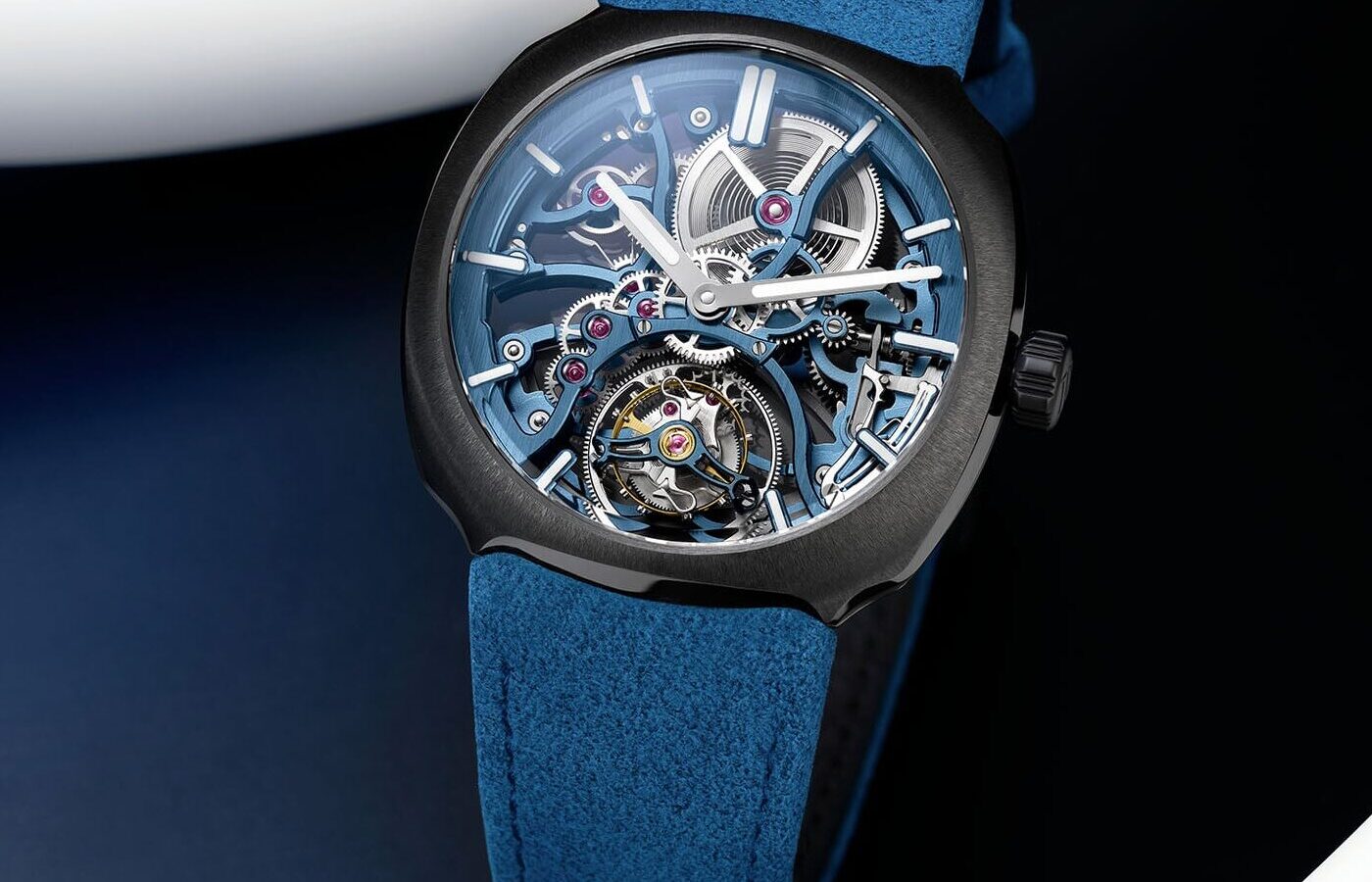
H. Moser & Cie. has unveiled the Streamliner Tourbillon Skeleton Ceramic Alpine Limited Edition, reference 6814-2100, limited to 100 pieces and presented in September 2026. It is the third watch to emerge from the manufacture’s partnership with Alpine Motorsports, following the Streamliner Cylindrical Tourbillon Skeleton Alpine Limited Edition and the Streamliner Alpine Drivers and Alpine Mechanics editions, and only the second H. Moser & Cie. timepiece ever to use a ceramic case, after the Streamliner Tourbillon Concept Ceramic shown earlier in 2026.
The premise here is straightforward but mechanically demanding: take a movement that has already been stripped down to its structural minimum and house it in a case material chosen specifically because it does not deform, oxidise, or wear the way steel or gold does over time. Ceramic is scratch-resistant, hypoallergenic, and lighter than the metals typically used for the Streamliner case, and it does not develop a patina. For a watch built around visible mechanics, that stability matters as much aesthetically as it does structurally.
Case construction and finishing
The case measures 40mm in diameter and 12.8mm thick, a figure that includes the slightly domed sapphire crystal. The Streamliner’s fluid, rounded case architecture translates directly into ceramic, and the finishing plays on that continuity: alternating polished and satin-finished surfaces catch light differently depending on the angle, giving the anthracite grey material a sense of depth rather than flat uniformity. A sapphire caseback allows the movement to be viewed from the reverse as well as through the open dial side, and the screw-down crown is engraved with an « M ». Water resistance is rated to 120m, respectable for a case built around extensive openworking rather than a solid dial and back.
Movement architecture: skeletonization as design language
Inside sits calibre HMC 814, an in-house self-winding movement measuring 32mm in diameter and 5.5mm thick, built from 167 components and running on 28 jewels at 21,600 vibrations per hour. There is no conventional dial here. The bridges and main plate are finished in blue, a direct reference to the Alpine Motorsports livery, and set in deliberate contrast against the anthracite grey ceramic case. An openworked barrel sits at 12 o’clock, and the overall skeletonised architecture is designed to let light pass through the movement rather than around it.
At 6 o’clock is a one-minute flying tourbillon fitted with H. Moser’s in-house double hairspring, produced by sister company Precision Engineering AG. The two hairsprings are engineered to compensate for shifts in the centre of gravity as they expand and contract, which is intended to improve precision and isochronism. The tourbillon’s own bridge is skeletonised and carries the same blue finish as the main plate, so the regulating organ reads as part of the same continuous structure rather than a separate component bolted onto an otherwise solid movement.
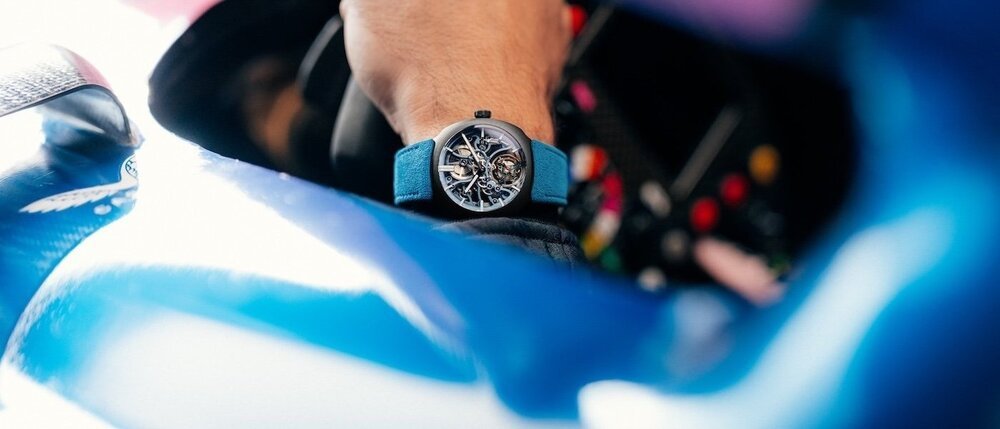
Winding is handled by a bi-directional pawl system connected to a fully skeletonised gold oscillating weight, which stores a minimum of 72 hours of power reserve. Even the rotor, in other words, has been treated as an opportunity to remove material rather than conceal it, which keeps the view through the case consistent from any angle.
Legibility on an open architecture
Removing the dial creates an obvious legibility problem, which H. Moser & Cie. addresses through Globolight, a composite material combining a ceramic base with Super-LumiNova. It is used for the hour markers as well as for inserts set into the three-dimensional hour and minute hands, giving the display a defined visual signature against the openworked backdrop without reintroducing a solid dial plate.
The watch is fitted to an integrated blue Alcantara strap, closed with a black DLC-treated titanium pin buckle engraved with the Moser logo. The strap’s textile construction and dark titanium hardware keep the accent colours consistent with the movement’s blue finishing rather than introducing a third material language at the wrist.
With a run of 100 pieces, the Streamliner Tourbillon Skeleton Ceramic Alpine sits as a focused case study in what ceramic case construction can support once a movement has been opened up this extensively. It is worth watching how H. Moser & Cie. carries the same case material forward, given that this marks only its second use across the brand’s output to date.