
TAG Heuer has revived its Carrera Chronograph Sport with a new 42mm stainless-steel case, timed to coincide with the inaugural Spanish Grand Prix in Madrid, where the brand serves as Title Partner and Official Timekeeper of Formula 1. The new watch replaces the 44mm-cased 2020 Carrera Sport Chronograph, and the case design changes are substantial: diameter down to 42mm, lug-to-lug reduced from 49.8mm to a figure reported between 48mm and 48.6mm, and thickness cut from 15.48mm down to 14.17mm. That last figure alone shaves roughly 1.3mm off the case profile, a meaningful adjustment for a watch that has always traded on a muscular, motorsport-derived presence.
The original Carrera dates to 1963, when Jack Heuer built it around a simple functional premise: a driver needed to read elapsed time at a glance during the Carrera Panamericana road race. The Chronograph Sport line descends from that idea but filters it through a more contemporary, tool-watch execution. The 2020 generation leaned hard into scale, and the new model doesn’t abandon that language so much as recalibrate it. At 42mm wide and 14.17mm thick, it still reads as a substantial sport chronograph on the wrist, closer in scale to the Omega Speedmaster Professional than to any of TAG Heuer’s more compact dress references, but it no longer carries the outsized bulk of its predecessor.
Case construction and finishing
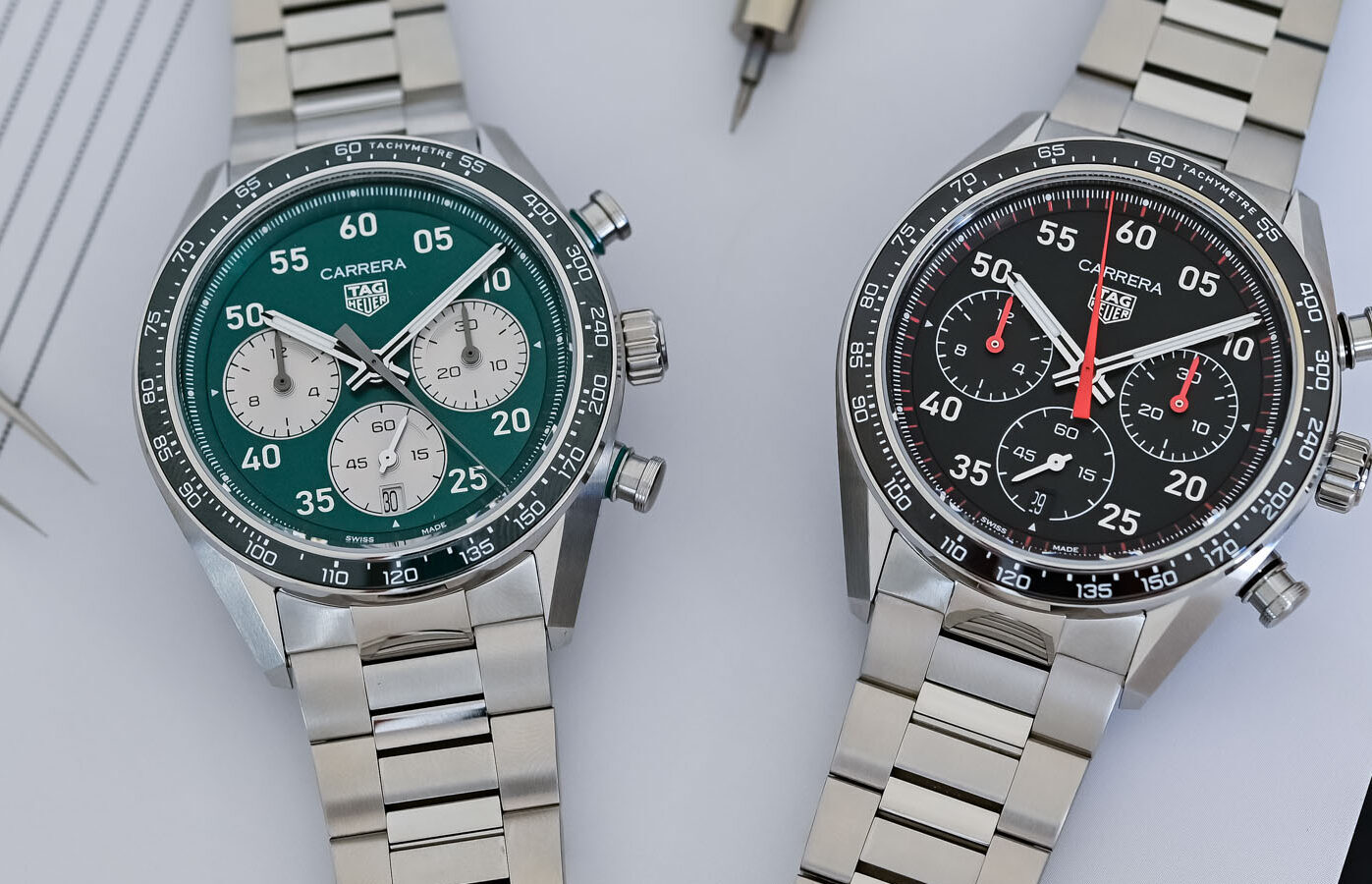
The case retains the alternating polished and finely brushed surfaces that have defined recent Carrera generations, but the execution has been redrawn rather than simply scaled down. The faceted Carrera lugs remain, now with more sharply defined sides and notably clean inner chamfers set against smooth brushed planes. The pump-style pushers, shaped to recall pistons or mechanical engine components, now feature coloured rings at their base and grooved rings on top, along with sharp polished edge rings that catch light during wear.
The fixed tachymeter bezel has been reworked into a thinner visual element, pairing a steel outer structure with a ceramic insert engraved directly with the tachymeter scale. A domed sapphire crystal with double-sided anti-reflective treatment sits over the dial, while the screw-down sapphire caseback carries an engraved Victory Wreath, a signature now common across TAG Heuer’s Carrera line. Water resistance holds at 100 metres, a sensible spec for a chronograph built around racing inspiration rather than serious diving credentials.
Dial design and legibility
The clearest break from the 2020 generation shows up on the dial. Baton-style applied hour markers give way to Arabic numerals for the double-digit minutes indication, a change that pushes the whole face toward a more instrument-driven, automotive character. The polished execution of these numerals catches light aggressively, particularly on darker dial colourways, giving the layout a gauge-like intensity that a standard baton-marker Carrera doesn’t attempt.
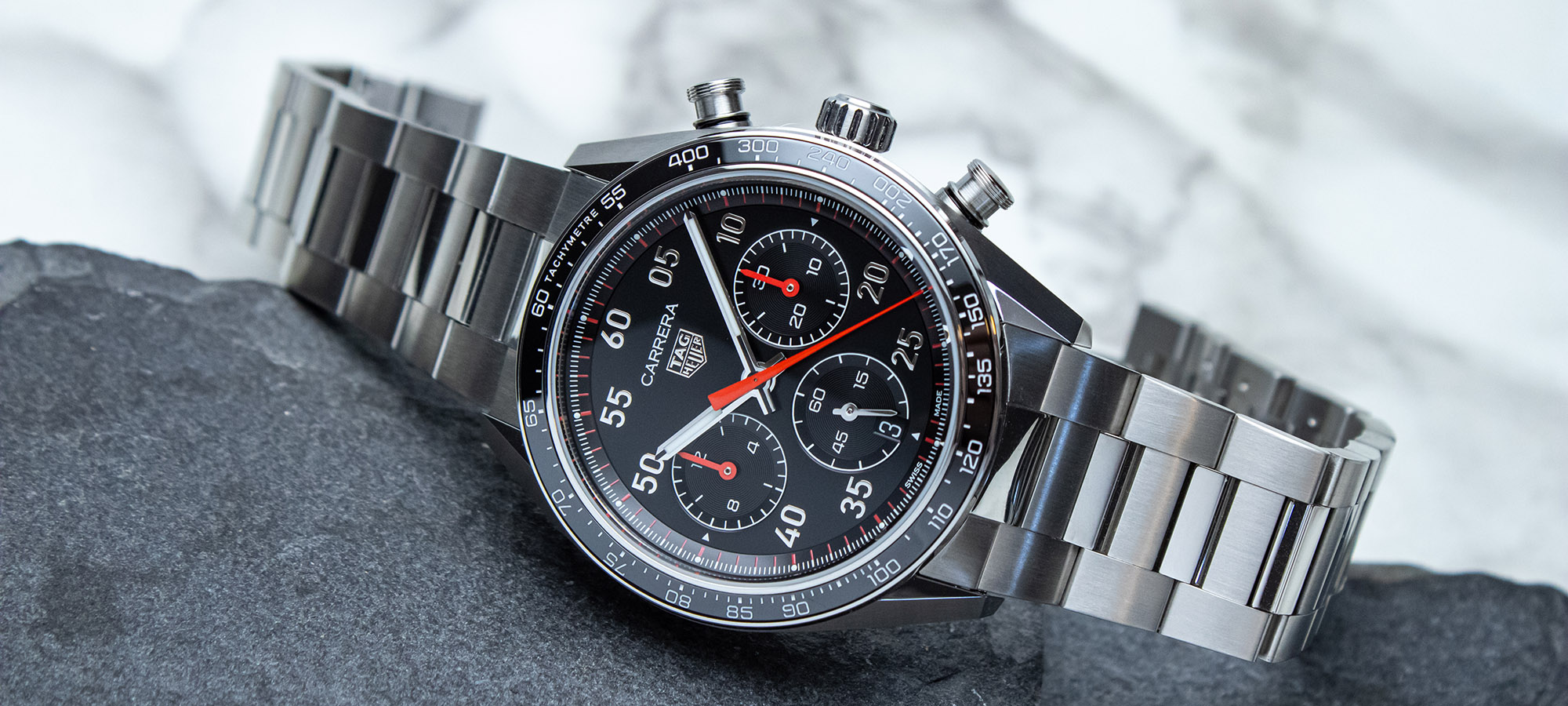
The underlying architecture stays familiar: a tricompax layout with the 30-minute chronograph counter at 3 o’clock, a 12-hour counter at 9, and running seconds at 6. The date aperture has been reworked to sit more discreetly, cut into the 6 o’clock subdial and colour-matched to it rather than interrupting the layout as a separate window. Hour and minute hands are rhodium-plated, faceted, and filled with white Super-LumiNova. Chronograph hands are grey-lacquered across most of the range, with the exception of the darkest dial option, which uses red lacquered hands and red-and-white chronograph markings on the flange for a more overtly racing-focused presentation. Colourways span a black opaline dial with azurage counters, a blue sunray-brushed dial with silver counters and a matching blue ceramic bezel, a green sunray-brushed dial with a matching green bezel, and a silver dial with black counters.
Movement architecture and bracelet engineering
Power comes from the in-house Calibre TH20-00, an evolution of the Heuer 02 that drove the 2020 Sport collection. It’s an automatic integrated chronograph running at 28,800 vibrations per hour, built around a column wheel and vertical clutch, and rated for an 80-hour power reserve. Visible through the sapphire caseback, the movement carries Geneva stripes, frosting, circular graining, and polished screw heads, along with a TAG Heuer shield oscillating mass finished with brushed and skeletonized surfaces.
On the wrist, the watch sits on an H-shaped steel bracelet, tapered for comfort and fitted with an easy-link adjustment system, secured by a folding clasp with double safety push-buttons. The blue dial version alone offers an alternative: a perforated brown calfskin strap closed with a steel pin-buckle triple-folding clasp, also with double safety push-buttons.
Availability begins in September 2026 for the steel-bracelet models, with the blue leather-strap version following in October across most markets. The size reduction, combined with the reworked dial and bezel, positions this Chronograph Sport as TAG Heuer’s clearest statement yet that a racing-inspired Carrera doesn’t need 44mm of case diameter to hold its ground.