
Hublot has built a 42mm watch designed to look like it’s been pumped full of air. The Classic Fusion Balloon Dog by Jeff Koons, announced in September 2026, is limited to 200 pieces per edition and comes in three versions: mirror-polished stainless steel, red anodized aluminum, and blue anodized aluminum. It marks Koons’ arrival as a Hublot ambassador, and it is also one of the more unusual case-engineering exercises the Classic Fusion line has undergone since its 2008 launch.
The reference point is obvious to anyone who has stood in front of one of Koons’ mirrored Balloon Dog sculptures, part of his Celebration series begun in the mid-1990s. Those works take a shape everyone recognizes, the twisted-balloon animal a street performer makes in thirty seconds, and cast it in permanent, high-finish material. Hublot’s task was to do the equivalent in miniature, in steel and aluminum, on a wrist-worn object that still has to function as a watch.
Re-engineering the Classic Fusion for volume, not just decoration
The Classic Fusion case is normally defined by a flat, restrained profile. That architecture had to be abandoned. According to Hublot, every component of this reference was reengineered through Koons’ visual language: inflated geometries, soft domed surfaces, and convex lines replace the line’s usual planes, so the case reads as though it were shaped by internal air pressure rather than cut from solid metal.
Getting there required rethinking the construction principles the Classic Fusion is normally built on. Julien Tornare, Hublot’s CEO, described it as a project where “every construction principle of the Classic Fusion” was challenged in order to fake inflation and volume without sacrificing watchmaking integrity. Practically, that meant every part was reshaped and then milled on 5-axis CNC equipment to achieve what Hublot calls a distinctive puffed form, followed by hand finishing to bring the surfaces to a final polished state. The 5-axis process matters here specifically because a continuously rounded, dome-like surface with no flat reference planes is difficult to hold to tolerance with simpler 3-axis milling; cutting it in one setup from multiple angles is what allows the puffed geometry to stay consistent across a run of parts before hand finishers take over.
Material choices across the three editions
The decision to offer this reference in mirror-polished stainless steel alongside red and blue anodized aluminum is directly tied to the sculptural reference. Koons’ Balloon Dog sculptures are prized for their mirrored, high-chroma surfaces, and a mirror-polished steel case is the most literal route to that reflective quality on a watch. The anodized aluminum versions push the color language further, giving the red and blue editions a saturated, toy-like finish that leans into the balloon-animal association more directly than steel does. Anodizing aluminum also allows for a consistent, durable colored surface without needing paint or coating layers, which matters on a case subjected to repeated handling and wrist contact.
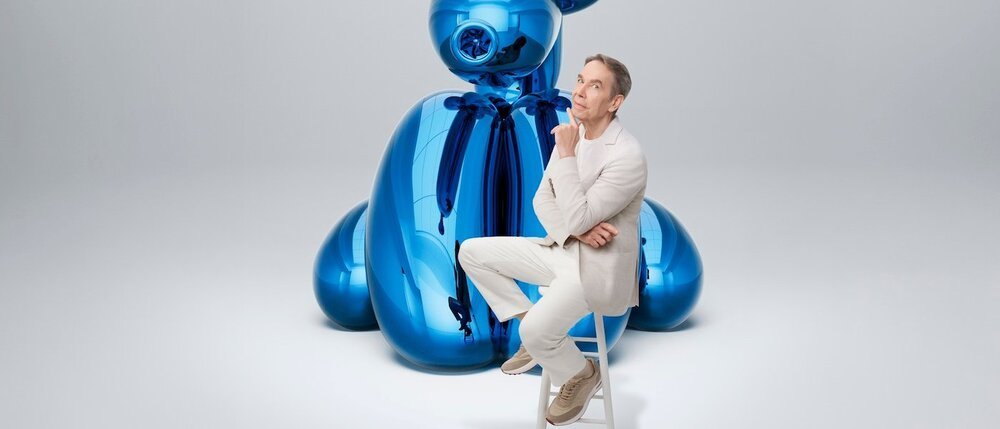
None of this reads as ornamental for its own sake. Koons himself framed the collaboration as an exercise in transcending material into meaning, stating that Hublot uses “all the technology of making master timepieces, and also uses the material sciences to transcend the object into representing something that all of us can find even more relevance and meaning.” Tornare, in turn, called the piece “an extraordinary exercise in engineering, craftsmanship and detail,” adding that what looks effortless and playful required reimagining, reshaping, and refining every component before hand finishing brought it to completion.
Where art direction meets watchmaking constraints
The interesting tension in a project like this is that a watch case still has to seal, hinge, and sit against a wrist comfortably, none of which a static sculpture has to manage. Hublot’s approach was to keep the Classic Fusion’s core identity, its 42mm scale and general architecture, while pushing the surface treatment of individual components toward continuous roundness and convexity. That is a different problem from styling a dial or hand set; it means every case flank, lug, and bezel edge has to carry the illusion of trapped air while still fitting together mechanically as a watch case normally would.
This is also consistent with the broader ambassador relationship Hublot has announced with Koons, who joins a roster of artists the brand has worked with since 2011. The framing on both sides emphasizes discipline behind apparent spontaneity: nothing about the puffed case surfaces is accidental, and the finishing work needed to make hard metal look soft and pressurized is, by nature, more exacting than producing a flat polished plane.
The Classic Fusion Balloon Dog by Jeff Koons is limited to 200 pieces in each of its three editions. For a design studio audience, its relevance sits less in the Koons name than in what the case-making process demonstrates: that 5-axis CNC roughing followed by hand finishing can be pushed to simulate soft-body, inflated forms in materials that are, by definition, rigid. That capability has implications well beyond a single limited run.