
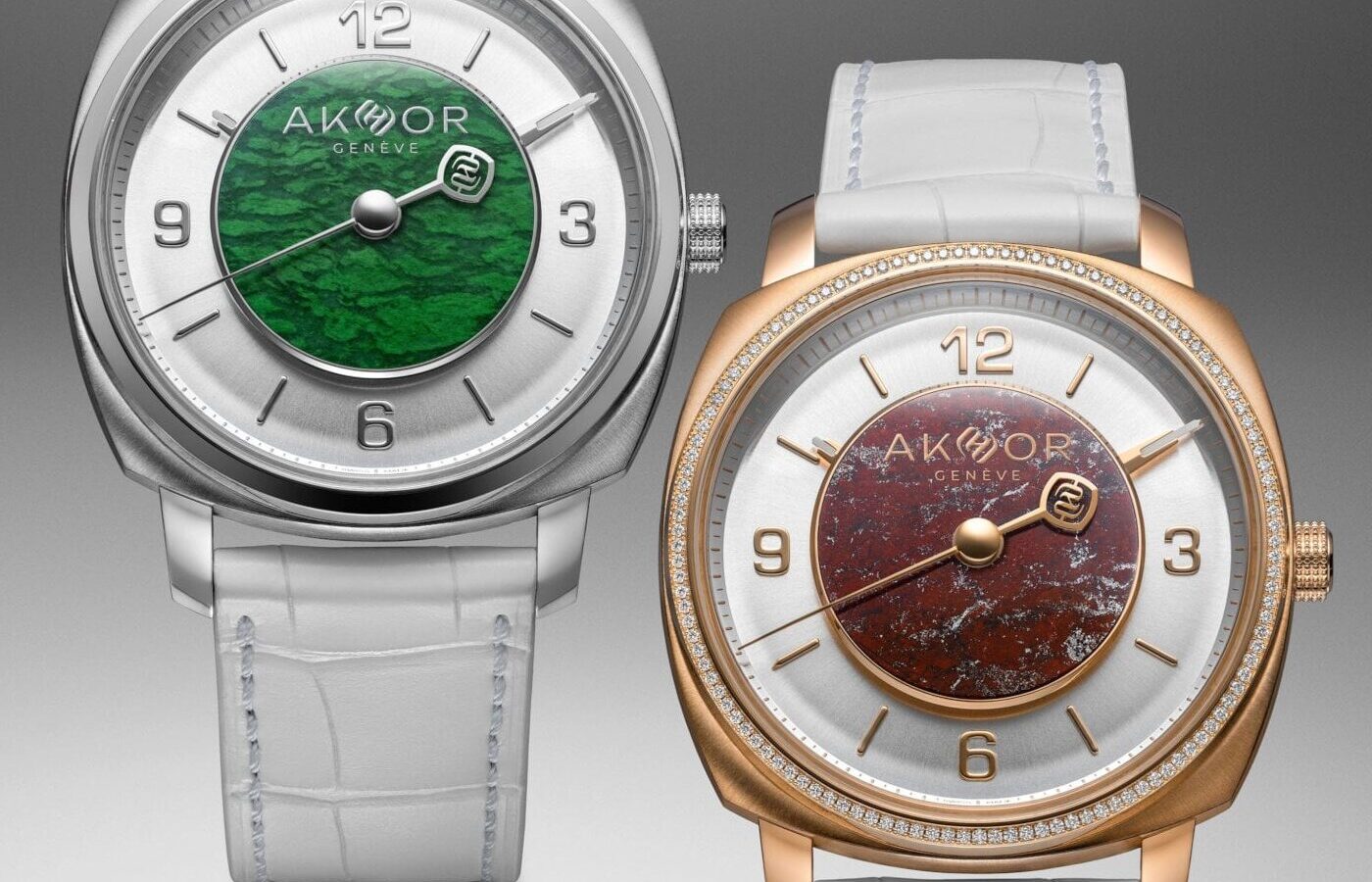
Akhor used Geneva Watch Days in September 2026 to introduce two new versions of its AK-10, each built around a dial material that most watchmakers never touch: stromatolite on the rose gold model, Maw Sit Sit on the steel version. Both stones are cut to a few tenths of a millimetre and set into the brand’s suspended upper dial disc, a patented two-level construction that Anissa Bader’s Geneva outfit developed with component manufacturer Clamax. It is a small, technically dense release, and it says a great deal about how far an independent brand will go to make a dial that cannot be replicated.
A dial architecture built to carry stone
The AK-10’s defining trick is not the material but the construction that holds it. The dial is a dual-disc system: a solid, suspended upper plate carries the central seconds hand, while the hour and minute hands sit hidden beneath that plate, visible only where they peek through to meet the chapter ring on the lower disc. It is the same architecture Akhor used on its debut piece, Le Temps en Equilibre, and it is what makes stone a viable dial material here in the first place. Because the upper disc is a separate, suspended element rather than a conventional printed or applied dial plate, it can be given over entirely to a mineral surface without compromising legibility of the hour and minute indications below.
Case dimensions are unchanged from Akhor’s time-only models: 39mm in diameter and 11mm thick, in the brand’s cushion-shaped profile, available in stainless steel or 4N rose gold. The crown carries Akhor’s hobnail knurling for grip, sapphire crystals front and back expose both the dial and the movement, and water resistance is rated to 30 metres. The rose gold case adds a bezel set with brilliant-cut diamonds. Both versions are fitted with hand-stitched white alligator leather straps, 20mm at the lug and 18mm at the clasp, closed with a folding clasp in gold or steel to match the case.
Working stromatolite and Maw Sit Sit
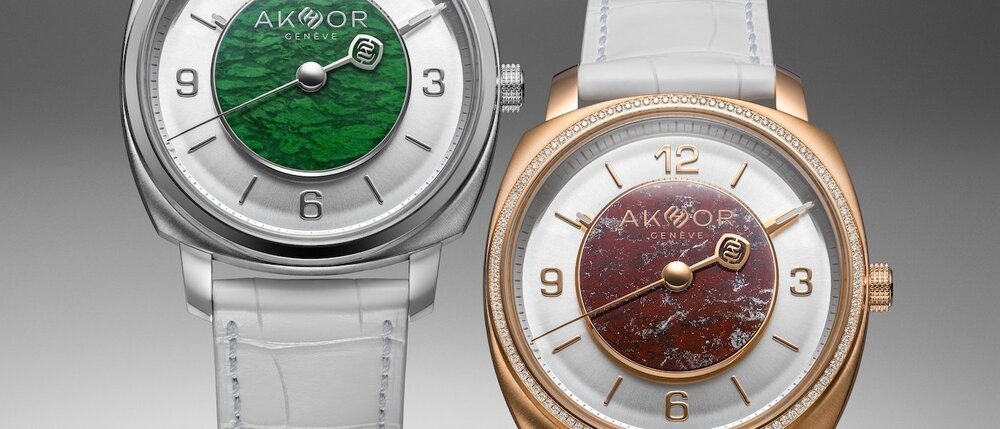
Stromatolite is fossilised microbial rock dating back roughly 3.5 billion years, among the oldest physical traces of life on Earth. On the rose gold model it appears in red, with swirling patterns of ochre, burgundy and brown that pair naturally with the gold case and appliqués. No two discs read the same way, since the banding is a record of geological deposition rather than a pattern that can be engineered or repeated.
Maw Sit Sit is rarer still in the strict sense: it comes from a single source, the foothills of Myanmar’s Himalayas in Kachin State, near the village that gives the stone its name. Swiss gemmologist Eduard Gübelin formally identified it in 1963, which makes it a comparatively recent addition to gemmology’s catalogue. Its colour is an intense, almost electric green, cut through with dark mineral veins, and its mineral composition is dominated by kosmochlor. That composition also makes it unusually demanding to cut. On the steel AK-10 it sits against the lower dial’s white sunray finish and applied nickel markers, a deliberate contrast between mineral green and metallic white.
Reducing either stone to dial thickness is where the real attrition happens. A solid mineral block has to be brought down to a few tenths of a millimetre before it stops behaving as mass and starts behaving as a thin, light-transmitting layer. At that thickness a hidden fissure or an invisible internal tension in the stone is enough to fracture the disc under the slightest excess of cutting pressure, and a share of discs simply do not survive the process. Only a finished, polished disc that passes that test is fitted into the case.
The calibre underneath
Both watches run the manual-winding calibre AK10, developed for Akhor and produced by Clamax, measuring 31.3mm in diameter and 3.9mm thick. It runs at 28,800 vibrations per hour, holds a 60-hour power reserve from a single barrel, and is built from 117 components with 12 jewels, including a variable inertia balance and a stop-seconds mechanism for precise time-setting. Finishing includes hand-applied anglage, fan-shaped Côtes de Genève, and decorated wheels. The movement carries the Poinçon de Genève hallmark and is certified both by the Observatoire Chronométrique de Genève and COSC, putting independent chronometer certification alongside the Geneva seal on the same calibre.
Given the extraction and cutting losses involved in sourcing usable stone discs, and the certification load already carried by the AK10 calibre, both models are likely to remain limited by the material itself as much as by any stated production number. More detail is expected as Akhor finalises availability through its own channels.