
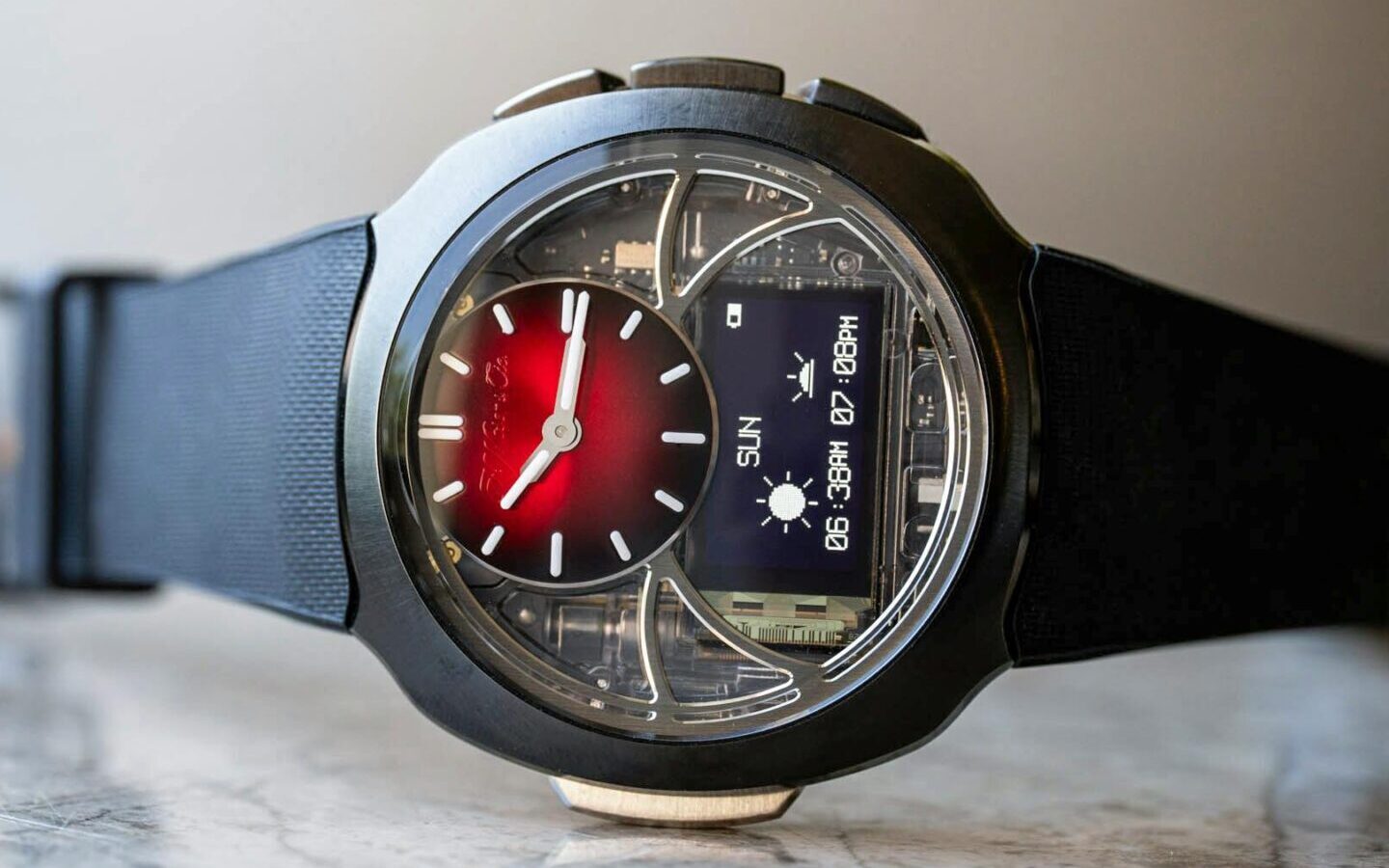
The H. Moser & Cie. Off-Grid arrived on September 21, 2026, as the brand’s second experiment in digital timekeeping and, by a wide margin, its most obtainable watch to date. It carries over the 42.6mm steel case and split-level construction first seen on the H. Moser & Cie. Streamliner Alpine Mechanics Edition, released the previous year for Formula 1’s Alpine team, but strips out that watch’s real-time pit-crew messaging in favor of a simplified digital mode built for everyday use. Two references are available: 6700-1202, in blue PVD steel with a black fumé dial and white rubber strap, and a black PVD version paired with a deep red fumé dial and black rubber strap.
What makes the Off-Grid worth examining from a case design standpoint is not that it’s new geometry. It isn’t.
Case Construction and the Split-Level Layout
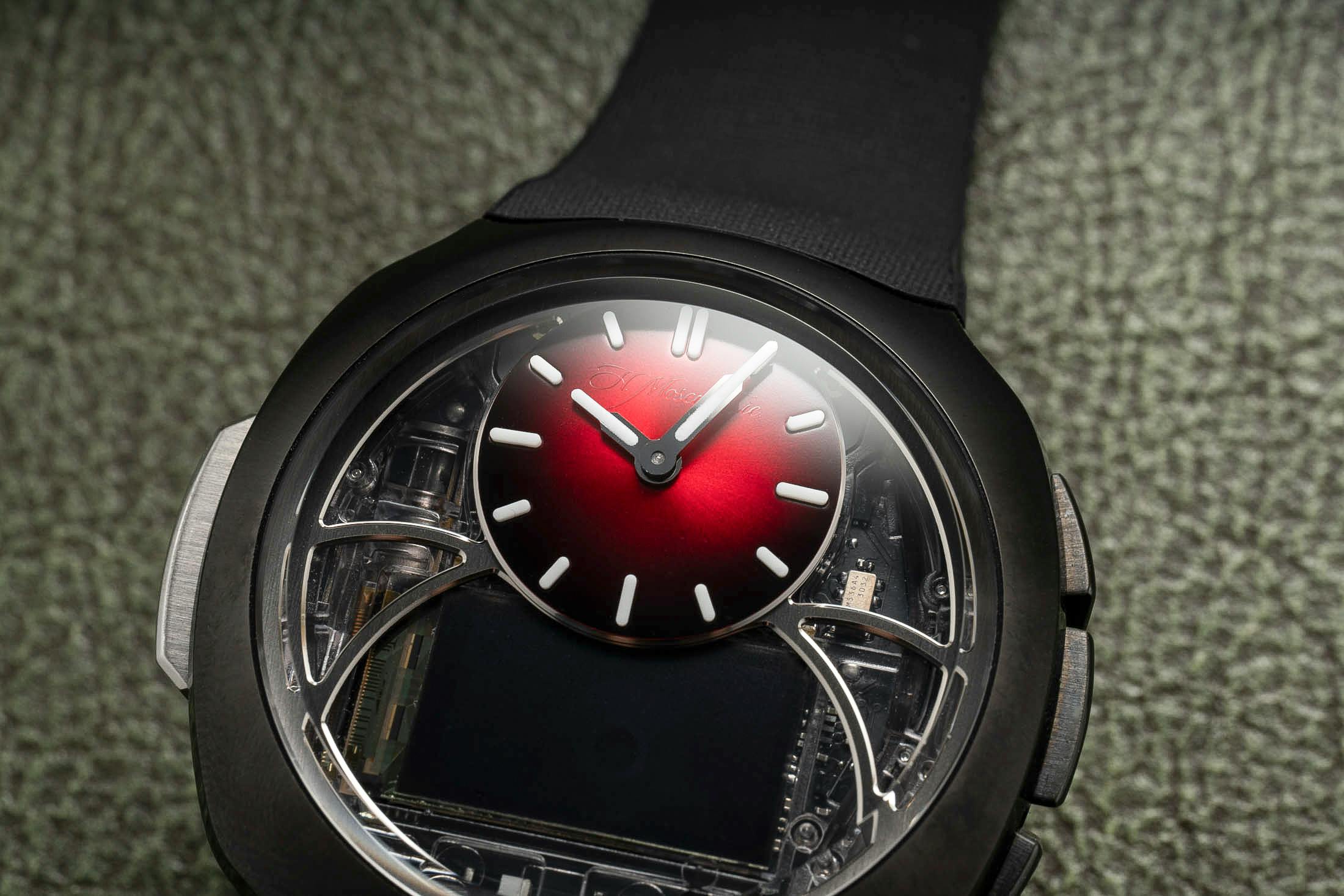
The defining feature of this case design is its division into two functional zones stacked within the same 42.6mm steel body: a miniaturized analog dial on top, rendered in fumé finish, and a digital display screen below it. This is the same architectural solution Moser used on the Streamliner Alpine Mechanics Edition, and its persistence here suggests the split-level format is now a fixed piece of tooling rather than a one-off engineering exercise for a motorsport partnership.
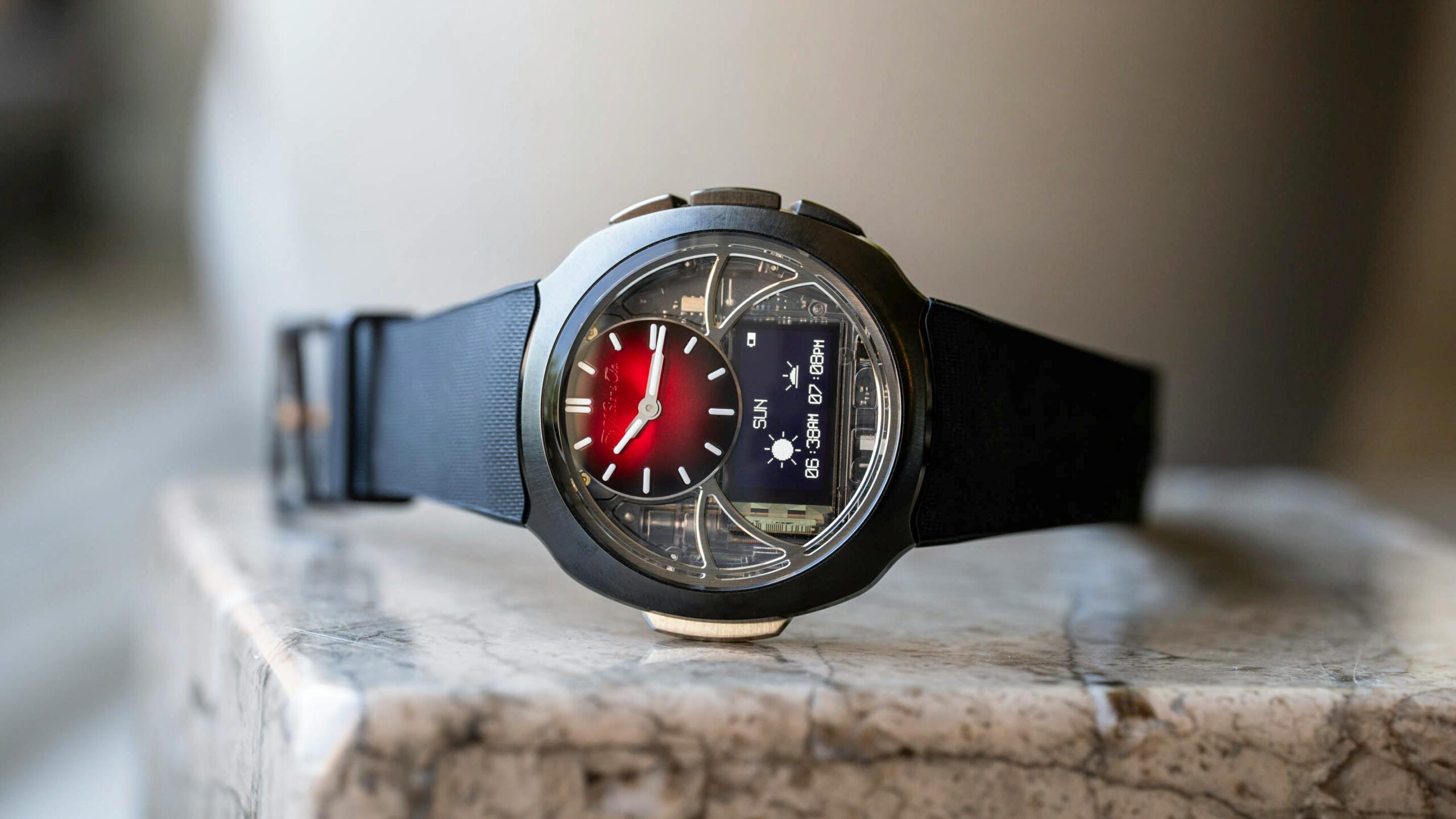
Two PVD colorways are offered on the steel case: blue with a black fumé dial, and black with a deep red fumé dial. Each is paired with a rubber strap in a matching tone, white on the blue version and black on the red-dialed piece.
Hybrid Module Integration: What Stayed, What Changed
Functionally, the Off-Grid retains nearly the full suite of timekeeping tools found on its motorsport predecessor: local time, a GMT function with a country selector covering all time zones, a split-seconds chronograph, a timer, a perpetual calendar, sunrise and sunset times, and a vibrating alarm. It adds one new function not present on the Alpine Mechanics Edition: a perpetual moon phase that updates hourly and is accurate for the next 100 years.
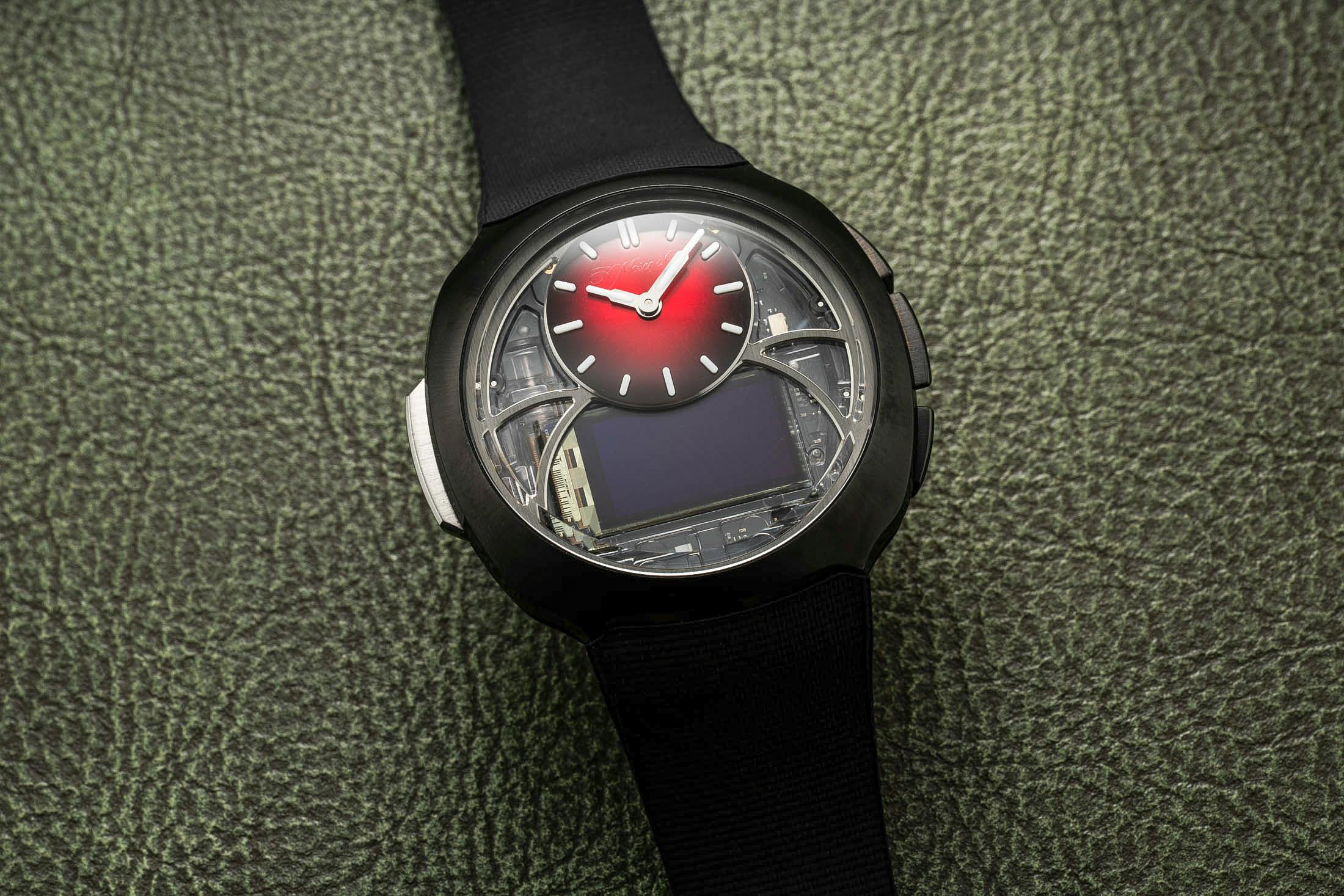
The real structural change is functional rather than mechanical. Where the Streamliner Alpine Mechanics Edition used its digital screen to relay live communications from the Alpine pit crew, the Off-Grid replaces that link with what Moser calls “Off-Grid” mode. A large button on the left toggles the display on and off. The upper right button cycles through a list of cities and their corresponding time zones. The lower right button calls up a dictionary of ten words, translated into more than 21 languages, tied to whichever city is currently selected on the display. The words are basic travel vocabulary: hello, goodbye, please, thank you.
Moser describes the name as “a deliberate departure from the established approach, leaving the well-trodden paths behind.” Whatever one makes of the phrasing, it points to the same underlying decision that shaped the case: take an existing hybrid module built for a specialized, connected use case, and re-purpose its screen for something with no dependency on a smartphone or external data feed.
Ergonomics of a Dormant Display
The digital screen’s tendency to go to sleep when not in active use was noted as a point of friction on the Streamliner Alpine Mechanics Edition, where a blank screen sat oddly alongside a tool meant for critical real-time messaging. On the Off-Grid, that same behavior reads differently. With no notifications and no inbound messages to wait for, a dormant screen becomes the expected state rather than an interruption. The practical result is that when the digital layer switches off, the watch settles back into something that wears and reads much more like a conventional Moser, with the fumé analog dial carrying the visual weight on the wrist.
Production and Availability
Moser is producing 1,000 pieces of each reference, for a total run of 2,000 watches, a volume the brand has not approached before. Both the blue PVD and black PVD versions are available now. For a manufacture built on low volumes and high exclusivity, the Off-Grid represents a deliberate test of how far its case architecture and hybrid module can stretch toward a broader audience without a ground-up redesign, and it will be worth watching whether this split-level platform reappears in further configurations.