
Tudor has revived the North Flag, discontinued in 2021, as the Northflag: now a single word, now fitted with a GMT function, and now built around a case and dial that had to be reworked to accommodate it. First shown hands-on by Monochrome Watches, the new reference keeps the 40mm case diameter of the 2015 original but changes nearly everything around it, a reminder that adding a complication rarely means simply inserting a new hand.
Case Design: Thinner, Shorter, More Refined
The original North Flag case measured 13.4mm thick with a 50mm lug-to-lug. The 2026 Northflag brings those figures down to 12.7mm and 48.8mm respectively, a reduction of 0.7mm in thickness and 1.2mm in lug-to-lug. Diameter stays at 40mm. On paper these are modest changes, but they alter how the watch sits on the wrist, tightening a case that Monochrome Watches described as having a certain bluntness in its original construction.
The stainless-steel case remains 100m water-resistant, angular, and mostly brushed, preserving the tool-watch character that defined the line. But the black ceramic ring that sat beneath the steel bezel on the original North Flag has been removed entirely. In its place is a fixed, brushed and angled steel bezel, thinner than before, which combines with a new box-shaped sapphire crystal to give the case a more slender profile. Sapphire also now covers the caseback, exposing the movement for the first time on this model line.
The screw-down crown at 3 o’clock has been reshaped into a more conventional form, though it still carries a detail distinct from the rest of the current Tudor catalogue. Finishing has also been sharpened: polished bevels now run along the edge of the bezel and at the 6 and 12 o’clock case corners, details absent from the more utilitarian original.
Dial Design: Rebuilt Around the GMT Function
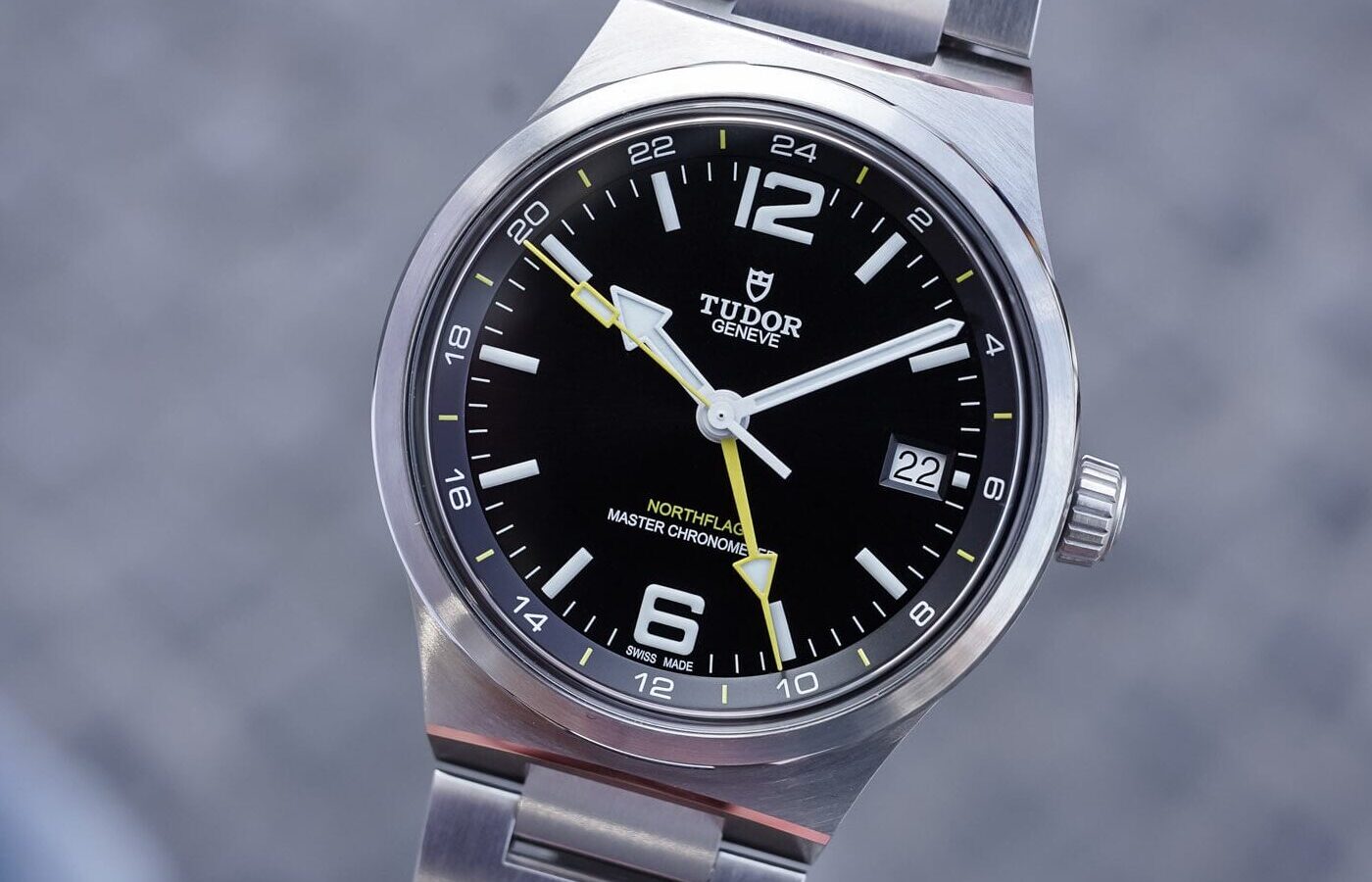
The clearest sign of the mechanical shift sits on the dial. The original North Flag’s rotating-disc power-reserve indicator at 9 o’clock, tied to the 70-hour autonomy of its calibre MT5621, is gone. In its place, the fourth hand now performs a genuine GMT function, finished in yellow with an arrow-shaped tip. The former minutes/seconds track, which ran along the inner flange, has been moved down closer to the dial centre, and a fixed 24-hour scale now occupies the space it vacated.
Other dial changes follow from this reorganization rather than from cosmetic preference. The yellow central seconds hand now carries a rectangular luminous tip instead of a trapezoidal one, a detail Monochrome Watches notes brings it closer to the design of the 1970s Ranger II that originally inspired the collection. The hour markers and numerals are now formed from monobloc ceramic containing luminous material, giving them a raised profile that adds definition against the dial surface. The matte black finish of the original has been replaced by a sunray-brushed surface, described as discreet in most lighting but visible at certain angles. The Explorer-style typeface continues, the date aperture remains at 3 o’clock, and the hour and minute hands keep their Super-LumiNova treatment unchanged.
The result, according to Monochrome Watches, is a dial that carries more information than before yet reads more clearly, a function of the symmetry introduced by moving the track inward and replacing the power-reserve display with the GMT scale.
Movement Architecture: Calibre MT5652-U
Powering the Northflag is calibre MT5652-U, an automatic movement already used in the Pelagos FXD GMT and the Black Bay GMT family. Manufactured with Tudor’s movement partner Kenissi, it runs at 28,800 vibrations per hour with a 65-hour power reserve, a change from the 70-hour reserve of the original North Flag’s MT5621. As a true GMT calibre, the local hour hand can be set independently in one-hour increments while the 24-hour hand continues tracking home time.
The movement combines a variable-inertia balance with a silicon balance spring and carries COSC chronometer certification alongside METAS Master Chronometer certification. It has 32 jewels and, unlike movements concealed in most traditional tool watches, is visible through a fluted-edge sapphire caseback.
Bracelet Construction
The Northflag retains an integrated-style steel bracelet built from broad H-shaped links, continuing the design language that gave the original North Flag its substantial, tool-watch presence on the wrist.
The Northflag arrives as a single-configuration release: one case size, one dial layout, one movement. For a line that spent six years dormant, the changes here are specific and mechanically justified rather than cosmetic, driven by the practical demands of fitting a GMT function into a case that previously prioritized a power-reserve display. Watchers of Tudor’s manufacture movement program, now built around Kenissi, will find the Northflag a useful marker of how far that partnership has extended across the collection.