
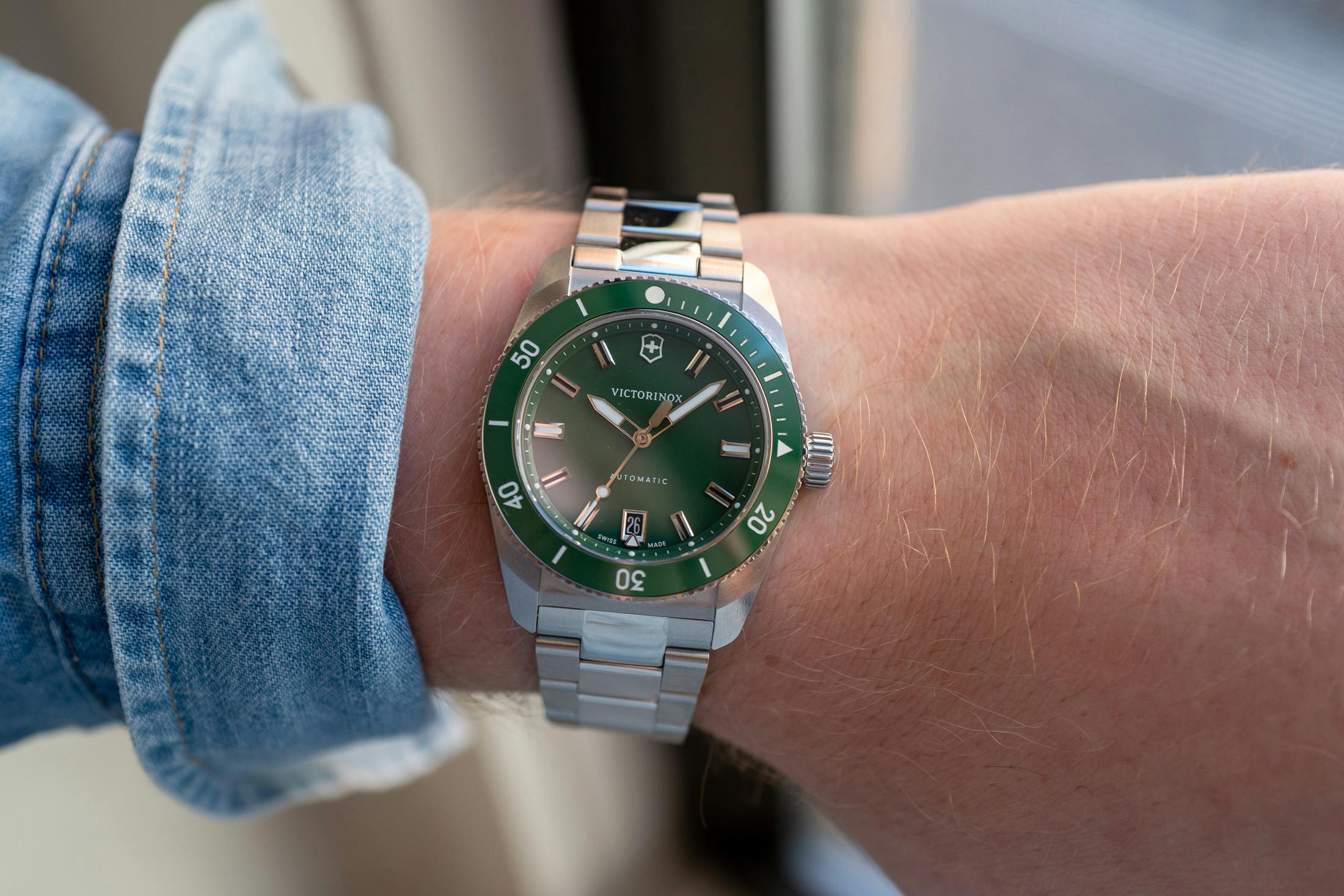
Victorinox has revised the Maverick for the first time in two decades, and the changes center on two things: a new case size and a dial layout built around legibility. The collection now spans 14 models, split between quartz and automatic movements, all developed and manufactured in Switzerland and all sharing a single 39mm stainless steel case. That case-size decision is the headline engineering fact here. Where the original Maverick occupied different territory in the catalog, this generation settles on one proportion across the entire line, quartz and automatic alike, which simplifies the case-design story considerably: one shape, one set of tolerances, one bracelet and strap interface, deployed across fourteen configurations.
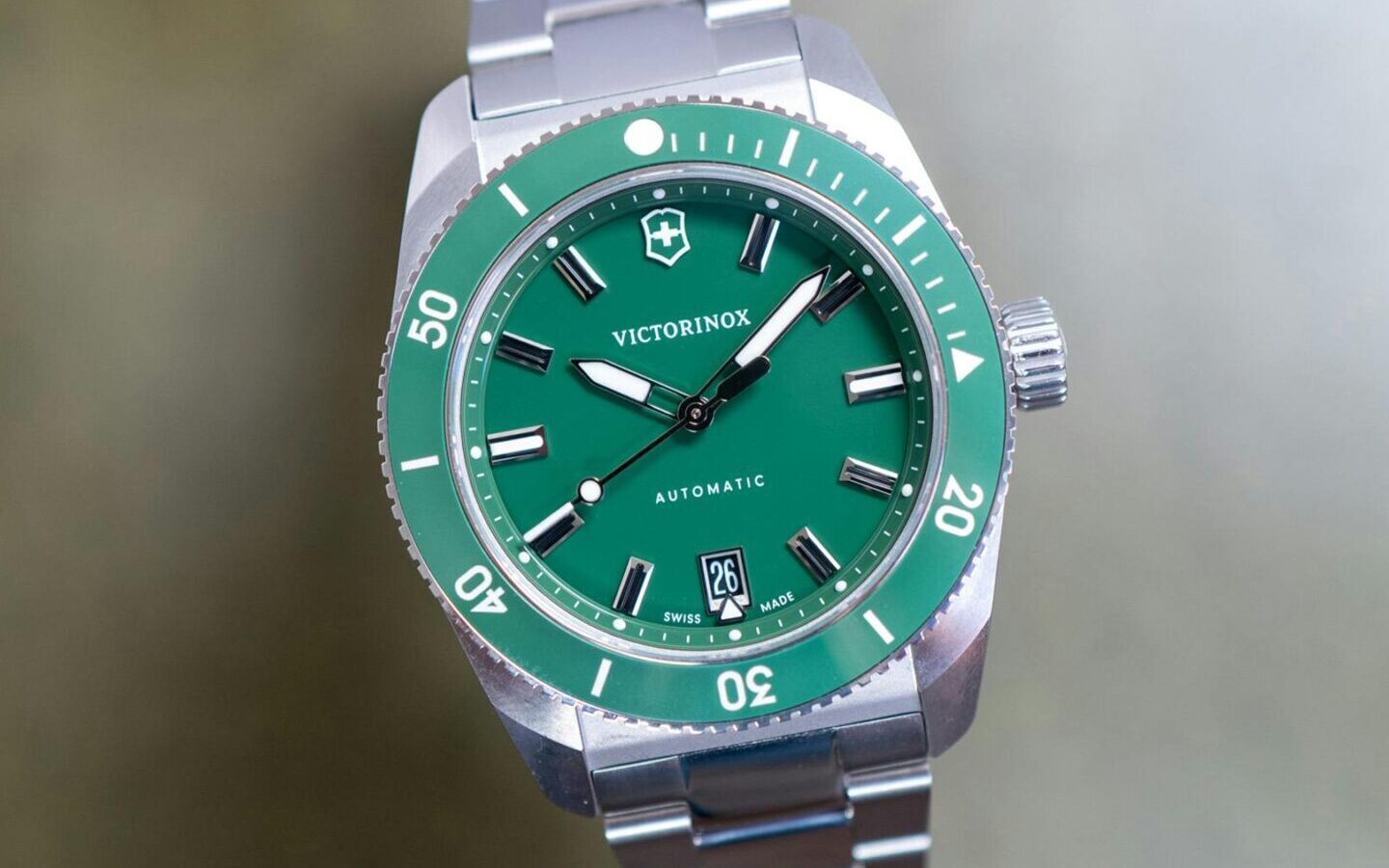
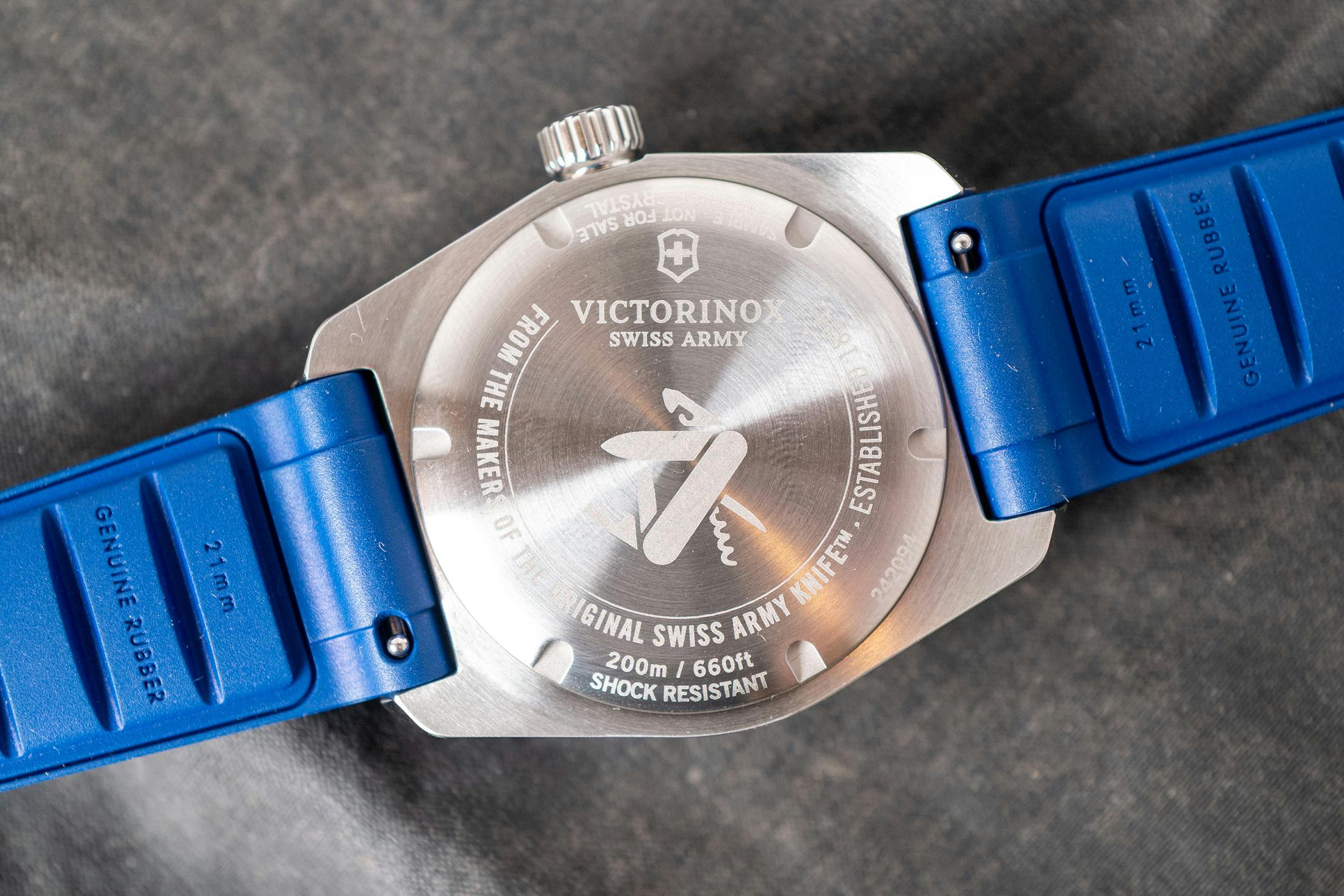
The case itself mixes brushed and polished surfaces and carries a unidirectional rotating bezel, a detail that signals continued allegiance to tool-watch proportions even as the collection courts a wider, more casual buyer. Depending on the model, that bezel is topped with either a high-polished mineral insert or a ceramic insert, and Victorinox has paired the ceramic option specifically with the automatic lineup. Water resistance has doubled, from 100 meters on the prior generation to 200 meters here, backed by double anti-shock protection built into the case construction. That’s a meaningful jump in a resized case, and it points to tighter case-back sealing and gasket work rather than simply a bigger case absorbing more pressure tolerance.
Dial Design and Legibility Under Different Light
The dial treatment is where the Maverick’s new identity really shows itself. Victorinox has gone with a metallic-finished dial and applied indexes that combine polished and sandblasted surfaces, a contrast finishing technique intended to keep the markers readable as light angles change throughout the day. Luminescent material sits on both the hour markers and the hands, reinforcing the tool-watch legibility brief the bezel already promises. Layout is straightforward: a date window at 6 o’clock sits in direct opposition to the Victorinox Cross and Shield logo at 12, a symmetrical arrangement that keeps the dial from feeling cluttered despite the layered finishing on the indexes.
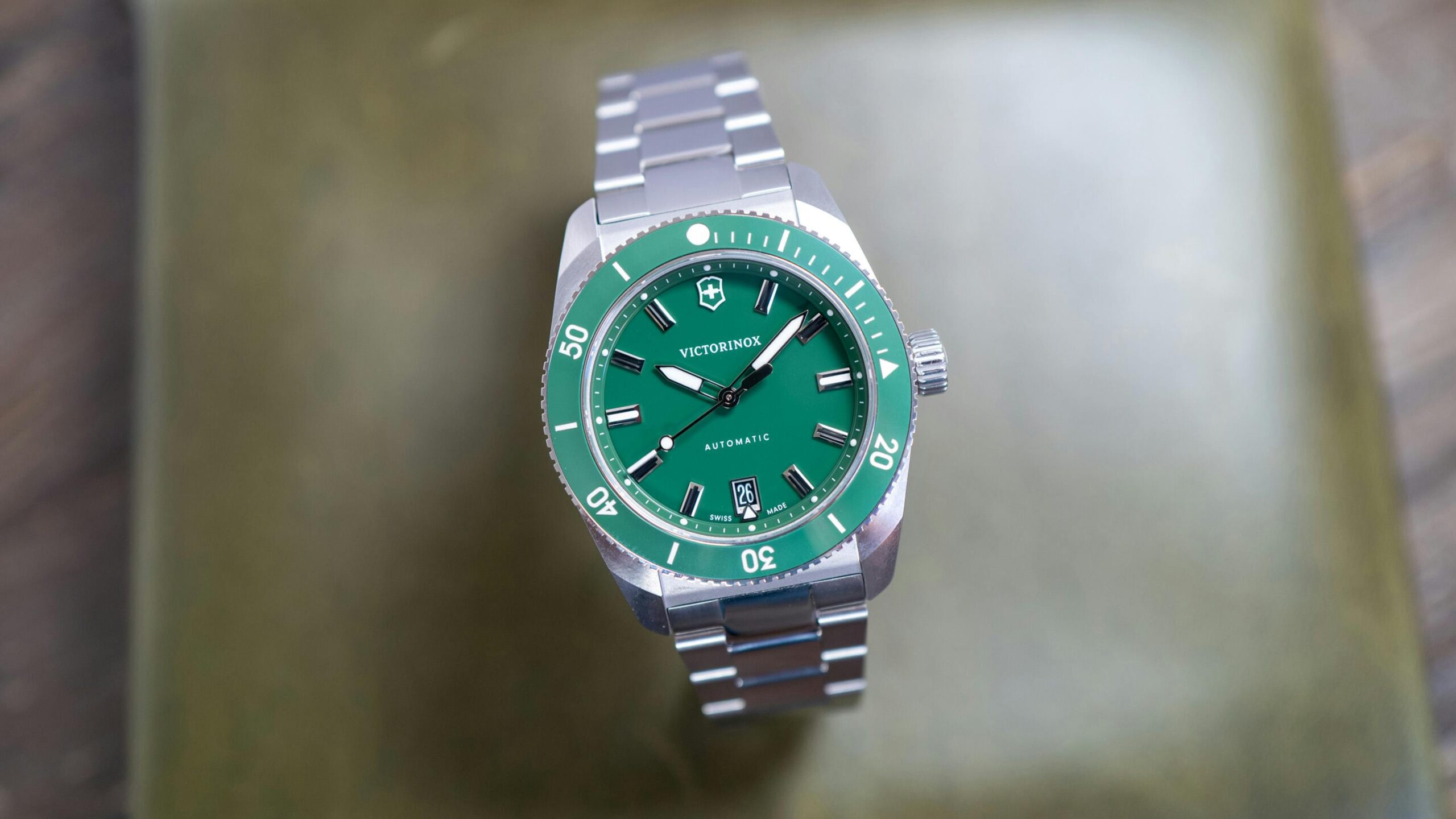
Underneath that dial, the two movement families diverge in both mechanics and market intent. The automatic Maverick range is the smaller of the two, four models total, all built with ceramic bezel inserts and powered by the Swiss-made Sellita SW200. Color options run to black, blue, and green, with the blue and green dial-and-bezel combinations paired exclusively with stainless steel bracelets; the black version is more flexible, available on either a steel bracelet or a black rubber strap.
A Wider Quartz Range for Everyday Use
The quartz side of the collection is considerably larger, with ten models built around the Swiss-made Ronda 715, a movement that Victorinox notes offers additional resistance to magnetic fields. These models use high-polished mineral bezel inserts rather than ceramic, and the color palette opens up substantially: black, blue, green, red, and ice blue dial-and-bezel combinations, spread across stainless steel bracelet and rubber strap options. Several two-tone executions round out the quartz lineup, introducing yellow-gold-colored accents to the case and bracelet, a configuration not offered anywhere in the automatic range.
Bracelets and rubber straps can be swapped without tools, which in practical terms means the same case can move between a steel bracelet for formal or office settings and a rubber strap for sport or water use, without a trip to a jeweler or a spring-bar tool at home. It’s a small mechanical detail, but it’s the kind of feature that changes how a watch actually gets worn day to day, and it reinforces the “all-purpose” framing Victorinox is putting around this generation of the Maverick.
What the Resize Signals
Put together, the smaller 39mm case, the doubled water resistance, the expanded color and two-tone options, and the tool-free strap mechanism read as a coordinated repositioning rather than a cosmetic refresh. For a collection with two decades of history behind it, that’s a substantial reset of the terms on which it competes, and it puts the Maverick in more direct contention with the broad field of everyday sport watches rather than a narrower tool-watch niche.